Duy's Oven, the Texas-spec offset line, built to order — choose your size:
The largest offset smoker Duy's Oven has ever designed: cooking chamber 2,700 litres (the Texas 750 gallon standard) plate steel 10mm, wood-fired for true Texas flavour, built for BBQ restaurants, professional production and catering. Each cook: 250–350kg brisket, ribs, pork butt.
In Texas the top pits, including the 1,000 gallon builds whose waiting lists now run to 2027, all share one principle: burn wood in an offset firebox and let only the heat and a clean stream of smoke pass over the meat. No electric elements, no gas: the real smoke flavour of wood burning bright on a bed of coals. Duy's Oven brings that exact standard to Vietnam, built in its own workshop from 10mm plate steel rolled as a single chamber.
Nearly 4 tonnes of steel is the "thermal flywheel": the pit climbs to 110–140°C and then sits there for hours, and after you open the doors to load it, 10–15 minutes is all it needs to recover. A thin-walled pit cannot do that, and it is why a 12-hour brisket comes off still juicy, with an even red smoke ring right out to the edge.
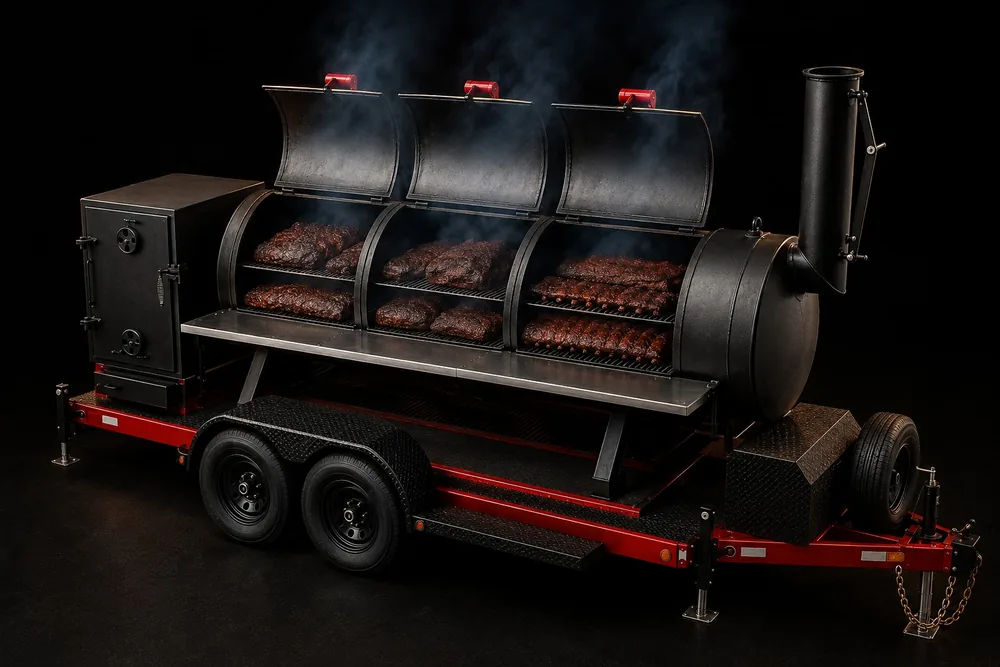
Smoke from the firebox passes through the throat 2,048cm² , which carries a flame baffle, then slips through under the adjustable tuning plates, runs level with the grate and only then leaves by a collector set near grate level, so the smoke never blasts straight onto the meat and no scorch spots form. Before delivery the workshop runs a heat map at 110/125/140°C and trims the tuning plates until the spread between zones is ≤15–20°C, giving exactly 4 heat zones: a hot zone for chicken and sausage, two steady zones for brisket and beef ribs, and a gentle zone at the far end for holding.
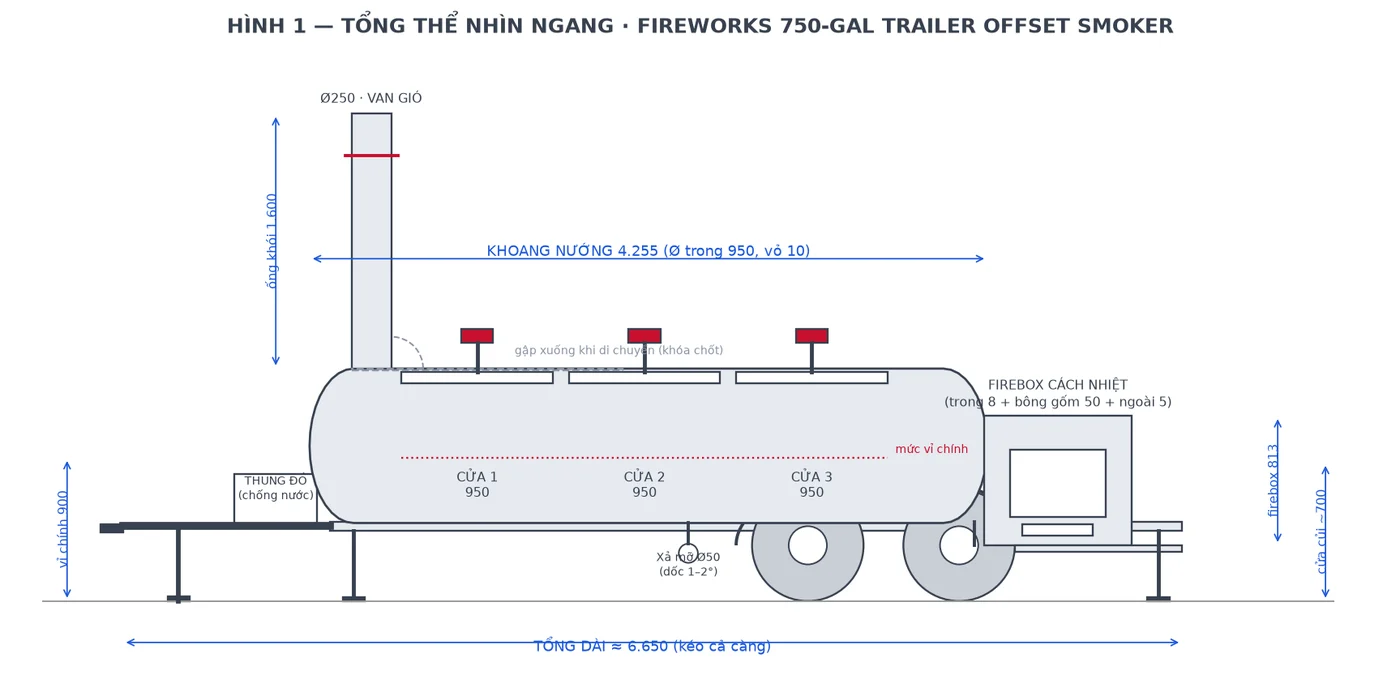
General arrangement drawing from the design file: the Ø950×4,255 chamber on low-deck saddles, firebox at the rear, folding Ø250 stack, main grate at 900mm so you can stand and cook all day without a sore back.
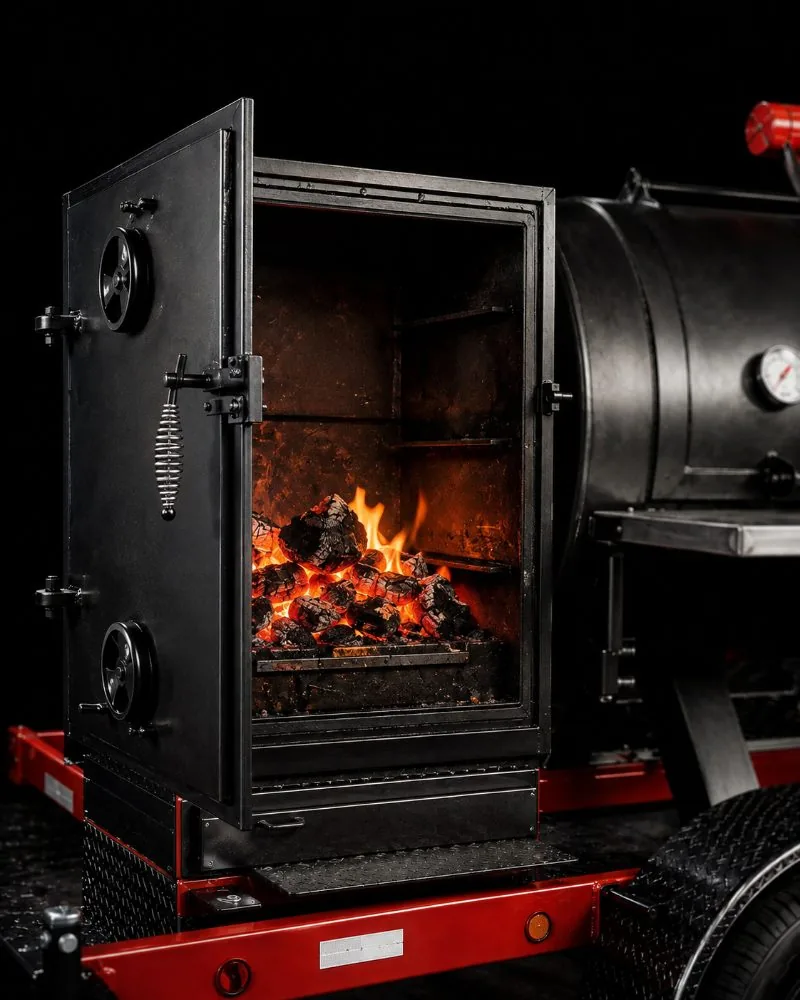
The firebox measures 800×800×750mm inside and swallows 30–35cm splits, built in 3 layers: an 8mm steel inner shell (a separate part, replaceable after years of burning), 50mm ceramic wool, and a 5mm steel outer shell. The grate sits 125mm up to keep air moving under the coal bed, the ash pan pulls out on its own, and both primary and secondary air have fine-adjust vents, so the fire stays small but clean, the smoke stays thin, and nothing turns acrid.
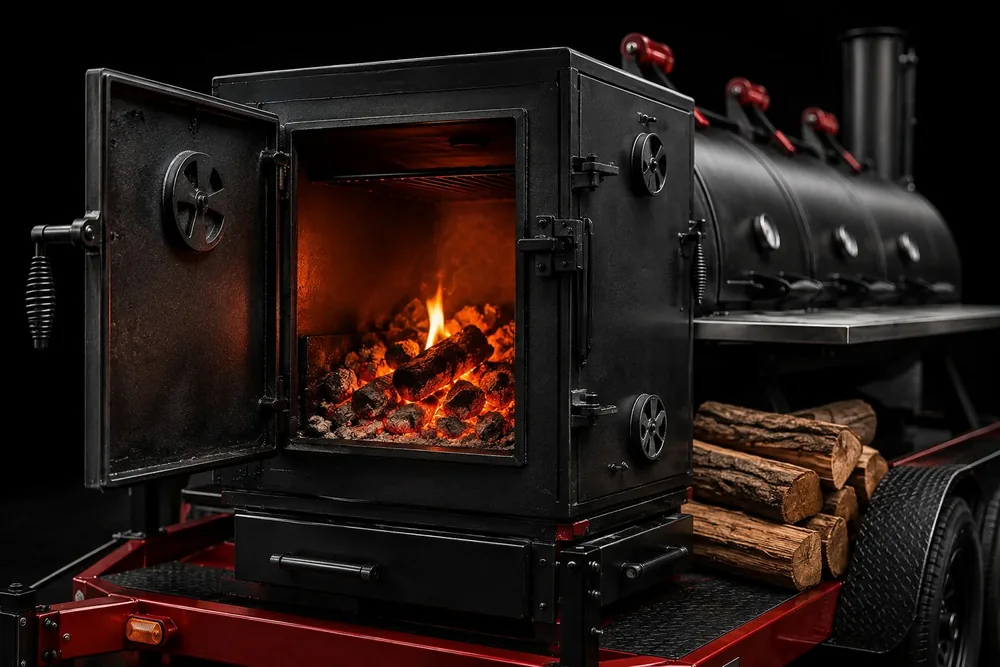
The firebox at work: a bed of coals covering the grate, a small flame licking across the top, the door opened one-handed on its counterweight latch. This is the state a pitmaster holds all cook long: a fire bright enough to keep the smoke clean, small enough to keep the chamber temperature still.
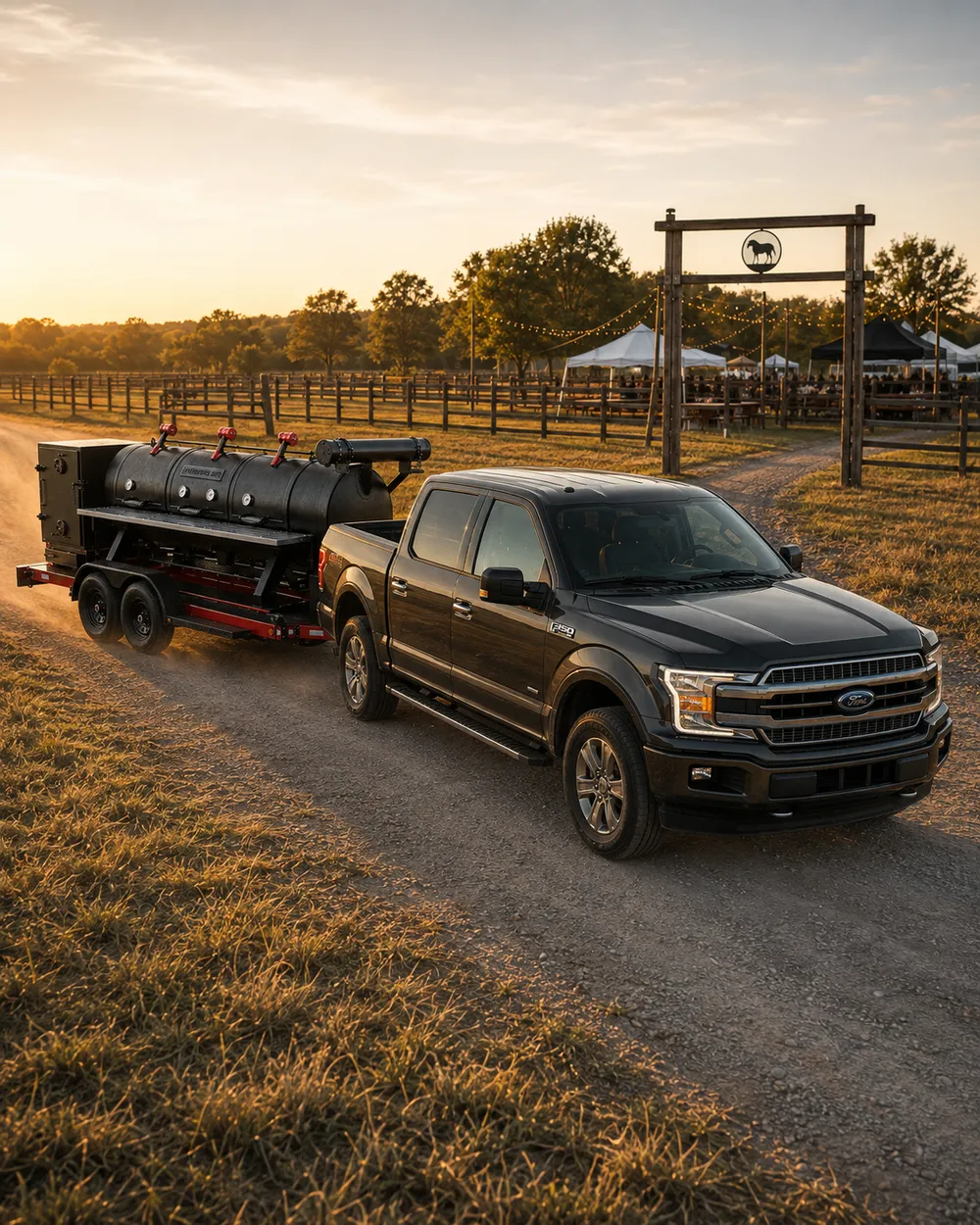
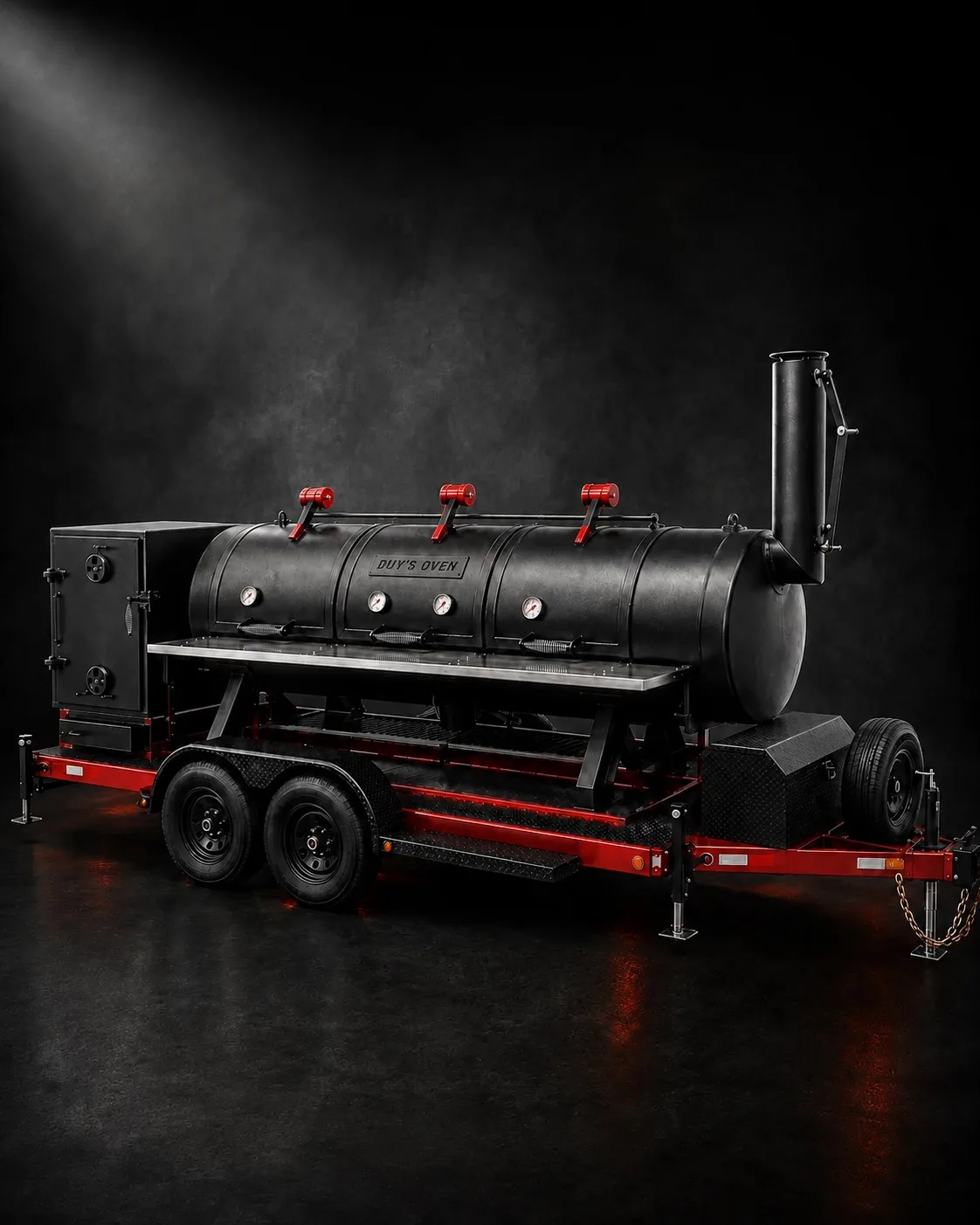
The whole build sits on a 2,750kg twin-axle trailer with electric brakes (GVWR 5,500kg), with the axles set on the real centre of gravity as calculated by an engineer, 4 corner jack stands, mudguards + LED lights + safety chains + spare wheel, plus a wood rack and a folding stainless steel serving shelf. The stack folds down and locks on a pin for transport. Note: the trailer price does not include vehicle inspection or number plates, so by default the pit is towed only on private grounds, at events on private land, or moved long distance on a truck; if you need to tow on public roads, the workshop will advise on a properly registered trailer frame when the contract is signed. The trailer frame is painted red to match the customer's brand identity (colour optional), and the pit body is finished in satin heat-resistant black.
This simulation runs a real heat balance, worked out from two tonnes of steel, 13.5 square metres of shell, the calorific value of the wood at a given moisture content and a 2.6 metre stack. Turn the two levels of air vent, the stack damper and the tuning plate gaps, then hit load the meat and watch. The part worth watching is the moment three hundred kilos of cold meat goes in: that mass holds more heat than the two tonnes of steel in the pit, so it drags the temperature down tens of degrees and keeps it there for nearly two hours. Newcomers see the needle fall, panic and stuff in more wood, and by three in the morning the pit surges and burns the bark.
Two jobs this pit knows well: an evening in the yard of a restaurant, and an outdoor party where it was towed straight to the spot.
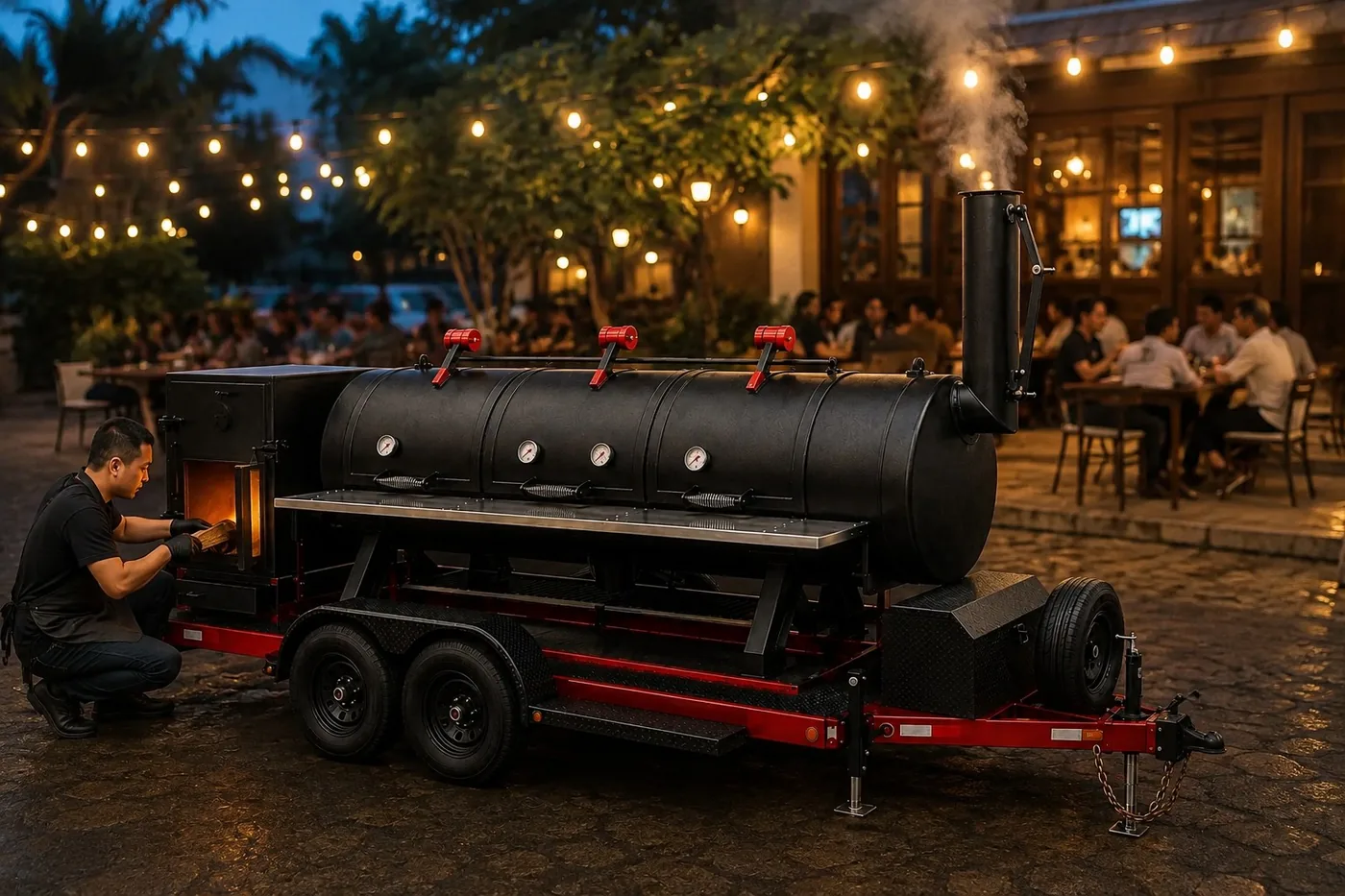
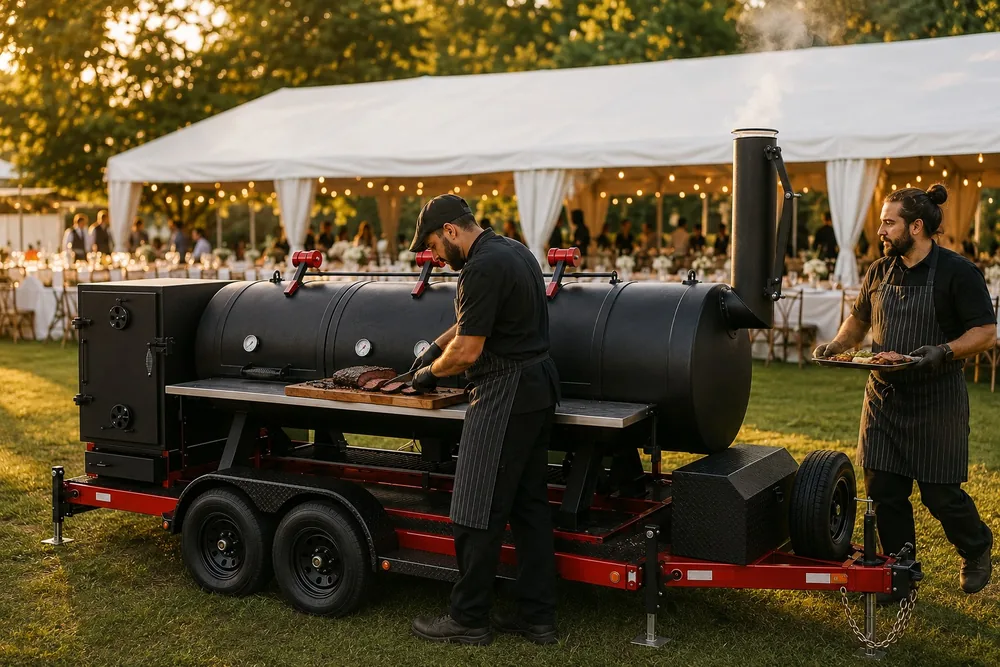
In the United States a pit this size is the heart of an entire business model, which is why builders like Mill Scale and Cen-Tex take orders a year ahead. Here are the 4 ways Duy's Oven customers work theirs:
One pit carries the whole smoking side of the house: 250–350kg per cook, one pitmaster minding the fire overnight, and by morning there is enough brisket, ribs and pulled pork for a full day of service. The 4 tonnes of steel hold heat steady, so every cook comes out like the last.
Hitch it to a pickup and tow it straight to the party ground. Drop the 4 jack stands and it becomes a field kitchen for 500–1,000 guests; the folding stainless shelf, the wood rack and the 12V lighting are already on the trailer.
A gloss black pit more than 6 metres long, trailing fragrant wood smoke, is the strongest sign your stand can carry. The trailer frame is painted in your own brand colour and fitted with your nameplate.
The 4 mapped heat zones let you run several cuts at once, the way competition demands; 4–6 digital probe ports serve teaching, recipe R&D and cooking by numbers rather than guesswork.
Each one is a bespoke build meant to last a lifetime: built to order, with a firebox inner shell made as a separate part so it can be replaced after years of burning, and 10mm steel that never reaches retirement age. Ordering a pit like this in the United States means waiting until 2027; from the Duy's Oven workshop in Vietnam it is delivered in 10 to 14 weeks.
| 750 Pro | 750 Standard | |
|---|---|---|
| Cooking chamber shell | 10mm steel — true Texas pit spec | 6mm steel |
| Pit weight / dry weight with trailer | ~2,320kg / ~3,780kg | ~1,760kg / ~3,210kg |
| Heat retention | Maximum thermal flywheel — stubborn heat, fast recovery after the doors open, suited to overnight brisket | 24% lighter and easier to tow — the heat needs a closer hand on a windy day |
| Firebox · tuning plates · charcoal grate | Identical on both tiers: 3-layer insulated firebox, 8mm tuning plates, 16mm grate | |
| Pit price (incl. 10% VAT) | 605.000.000₫ | 473.000.000₫ |
The twin-axle trailer at +385,000,000₫ is the same for both tiers. A restaurant cooking every day, with long brisket nights: take the Pro. Weekend catering that needs a lighter tow: the Standard is enough.
| 2700L (750 gal) | 3600L (1000 gal) | |
|---|---|---|
| Cooking chamber | Ø950 × 4,255 | Ø1,100 × 4,200 |
| Per batch | 250–350kg | 320–450kg |
| Dry weight with trailer | Pro 3.78t · Std 3.21t | 4.57t (GVWR 7,000) |
| Pit price (incl. 10% VAT) | 605M₫ / 473M₫ · trailer +385M₫ | 759M₫ · trailer +462M₫ |
Figures taken straight from the workshop's records, updated whenever the build changes.
The figures below are taken from this pit's own specification and recalculated by heat balance; see the simulation above as well. For the first three cooks you still have to weigh your wood and shoot the shell temperature to settle the numbers for your own pit.
Brisket arrives frozen. A 6.5 kg packer takes 60 to 72 hours to thaw in a 2°C chiller, so a full load of 46 packers needs roughly 1.5 cubic metres of chiller space and has to come down three days ahead. First-timers pull the meat down the afternoon before, then find at eight in the evening that the briskets are still frozen solid. At that point you either lose the cook or thaw in water, and thawing 46 packers in water is the fastest way to contaminate the whole load.
A pit straight out of the workshop still carries mill scale, cutting oil and weld slag on its inside surfaces. Run it empty at 250 to 300°C for three to four hours with the vents wide open, let it cool completely, then wipe on a coat of cooking oil and burn it once more to season the steel. The silicone-based heat-resistant paint on the firebox shell needs that same heat cycle to cure, and cooking meat on fresh paint ruins both the paint and the meat.
Once those two empty burns are done, cook your first three loaded runs on pork butt and pork ribs, and leave the brisket alone. Those three are the cooks where you weigh the wood, shoot the shell temperature and remap the four zones of your own pit, and pork costs a third as much and forgives far more because the fat already sits in the grain. Nobody learns to drive in a loaded container truck.
On cooking day you light with small thin-split wood and feed it until the floor of the firebox carries a coal bed about a hand span deep. That bed is what actually burns a full split. Put the first split on a bed still thin and it only chars on the outside and smoulders, and you take an hour of thick white smoke right at the head of the cook.
Once the coal bed is set you reach the step beginners skip, and it costs them two hours every cook. Three hundred kilograms of meat coming out of the chiller is a larger heat sink than the two tonnes of steel in the pit: 1,020 kilojoules per degree against 980 for the steel. Bringing that meat from 5°C to 120°C takes 117 megajoules, half again as much energy as heating the entire pit from cold.
So you warm the pit up to 145–150°C before you lay the meat in, then let it drift back to 120°C over the first two hours and keep the wood rhythm unchanged. The gauge falling over those two hours is physics, not a weak pit. Whoever sees the needle drop and stuffs in more wood ends up at three in the morning with the pit surging to 160°C, the bark burnt and the fat in the bottom hot enough to catch.
Through the cook you keep a rhythm of one feed every 25 to 30 minutes, one or two splits of 30 to 35cm each time. A split dropped into the pit cold takes 5 to 8 minutes to catch properly, and all through that stretch it gives off unburnt pyrolysis gas, which is the thick white smoke that settles on the meat. Stack a few splits on top of the firebox so they warm through and dry on the surface first, and that dirty-smoke stretch shrinks to 2 or 3 minutes.
For that rhythm to run smoothly, the wood has to be seasoned down to 16 to 20 percent moisture. At that level its heating value is still about 15 megajoules per kilogram, while wood at 30 percent gives only 12. Vietnamese firewood seasoned under a roof, stacked clear of the ground and split small comes down to that level within a few weeks, because the equilibrium moisture content of southern air sits around 16 percent.
What tells you how the fire is doing is not the gauge, it is the mouth of the stack. Thin blue smoke, almost invisible, means the fire is burning clean. Thick white smoke means pyrolysis gas is running straight through the throat without burning, and it settles on the meat as bitterness and in the stack as creosote. Grey-yellow smoke means the fire is badly starved. You cannot read any of this from the flame, because the coals at the bottom go on burning normally; you have to watch the mouth of the stack.
The fix is to open the upper air vent so oxygen reaches the gas where it rises, and to leave the stack damper alone.
Since we are on dampers, this point needs saying plainly. Keep the stack damper nearly wide open for the whole cook. Closing it does raise the temperature, but it raises it by trapping dirty smoke in the chamber, because that damper also throttles the secondary air that feeds clean combustion. To bring the temperature down, close the intake vents; to bring it up, open them. This is where beginners get it backwards most often.
The internal temperature climbs to about 65°C and then stops, sometimes for three hours. Moisture weeping to the surface evaporates, and that evaporation carries off exactly as much heat as the pit is putting in, so the two cancel out. At around 72°C the surface dries and the core starts moving again. Wrapping in paper gets you through faster, at the cost of a softer bark.
Once past the stall the rest goes quickly. Brisket is done at 95 to 97°C internal, and the probe should slide in like probing soft butter. Rest it for at least an hour, then hold it in a warming cabinet at 63 to 68°C until you slice.
After every cook you scrape the fat off the chamber floor and off the face of the tuning plates. Beef fat left to sit sets as hard as candle wax, and at that point you are chiselling rather than scraping, while a thick layer of fat in a pit running hot is where a grease fire begins. Ash in the pan stays live for 24 to 48 hours, so tip it into a metal bin with a lid, never a plastic one and never left behind at the venue.
Ordered by severity. The first group can kill you, so read all of it before you light the first fire.
Carbon monoxide. A wood-fired pit gives off carbon monoxide, a gas with no colour and no smell. Any roof over the pit must be open on all four sides, and the pit must never be moved into a closed house, a warehouse, or under an enclosed shelter. The generator running your warming cabinet also gives off CO, so it too has to stand outside and well away from people.
Towing the pit with coals still in it. Exhaust from a 700°C bed of coals sitting directly behind the vehicle is drawn back into the cab by the low-pressure wake behind a pickup. A driver who has been awake for eighteen hours, windows up, air conditioning on recirculate: that is a real scenario, and it has killed people.
Do not leave the pit for four to six hours after you shut the fire down. Once you close the vents, the firebox still holds 10 to 20 kg of live coals inside a three-layer insulated box, which is to say a thermos. At that point the pit is neither cool enough to tow nor safe to walk away from. A cook that finishes at half past ten in the morning cannot move until four or five in the afternoon, and that has to be written into your venue rental agreement.
Flame rolling out of the chamber door. For ten minutes after you add wood, the 2,800 litre chamber is full of unburned pyrolysis gas. Opening a door of more than half a square metre at chest height pumps oxygen into that gas. Wait the full ten minutes, and wait until the smoke at the stack has cleared, before you open.
The trailer is not yet road legal. The trailer as sold has neither a vehicle inspection certificate nor licence plates, so it may not be towed on public roads. Decree 168 of 2024 provides for confiscation of the vehicle, which means this risk alone is large enough to write off the entire package. If you intend to use it on public roads, take the matter up with the Vietnam Register before you order, not afterwards.
The shell is hot without glowing. With the chamber running at 120°C, the outer shell sits at roughly 95 to 110°C. Under ISO 13732-1, touching steel above 70°C burns instantly, before you can pull your hand away. More than four metres of pit body is at that temperature with nothing visible to warn you.
The doors are heavy. Each curved door weighs roughly 100 to 130 kg. The counterweights make them light to open, but if a counterweight fails or a gust catches a door, that mass is still that mass.
Climbing up to reach the stack damper. The top of the stack sits about 2.8 to 3.2 metres above the ground. People will climb onto the trailer or onto the pit itself, on wet steel, next to patches of 100°C metal that do not glow to warn them. If the damper has no ground-level control rod, one should be fitted.
Jack stands, and unhitching on a slope. Each jack stand carries 430 to 645 kg. Cheap jacks fail under that load, and they fail at the moment someone is bent over the tongue. Holding 4.3 tonnes on a 5 percent grade takes 215 kg of force, which no person can do, so chock the wheels before you unhitch. There are no exceptions.
Caustic soda for cleaning. Hot water mixed with caustic soda thrown onto steel that is still hot splashes straight back at your face. Wear a face shield and long rubber gloves, never use it on hot metal, and never mix it with anything else.
Grease fires and creosote fires. Grease in the bottom of the chamber and creosote in the flue will both catch fire. The warning signs are a roaring sound inside the stack and sparks coming out of the top. Close every vent to starve the fire, and never throw water onto burning grease.
Wood you must never burn. Painted wood, chemically treated wood, particle board, plywood, pallet wood of unknown origin and any tree with toxic sap must never go into the firebox. Their smoke goes straight into the meat you sell to your customers.
Clean water and cross-contamination. The trailer carries no water. No water means no handwashing station, and a handwashing station is a legal requirement for food service. Bring a clean water tank with a tap, keep separate knives and boards for raw and cooked meat, and never let the person who has just emptied the ash pan go and slice meat.
The figure of 250 to 350 kg per cook is a pork butt figure. For brisket, five square metres of grate comfortably holds thirty-three packers, which comes to 210 to 230 kg.
The smallest unit of work this pit accepts is a seventeen to eighteen hour commitment, plus four to six hours waiting for it to cool. Any event that needs food within five hours is beyond it.
This is also not a direct grill. The grate sits at 900 mm, the chamber runs at 120°C and there is no fire grate beneath the food, so you cannot sear a steak on it and you cannot cook skewers. Chicken comes off with rubbery skin, because chicken skin needs more than 150°C to crisp.
And this pit does not run itself, because it has no electricity, no gas, no fan and no controller of any kind. A wood rhythm of 25 to 30 minutes means nobody sleeps more than 25 minutes at a stretch for fourteen hours. That is thirty-seven labour hours per cook, and no upgrade brings that number down.