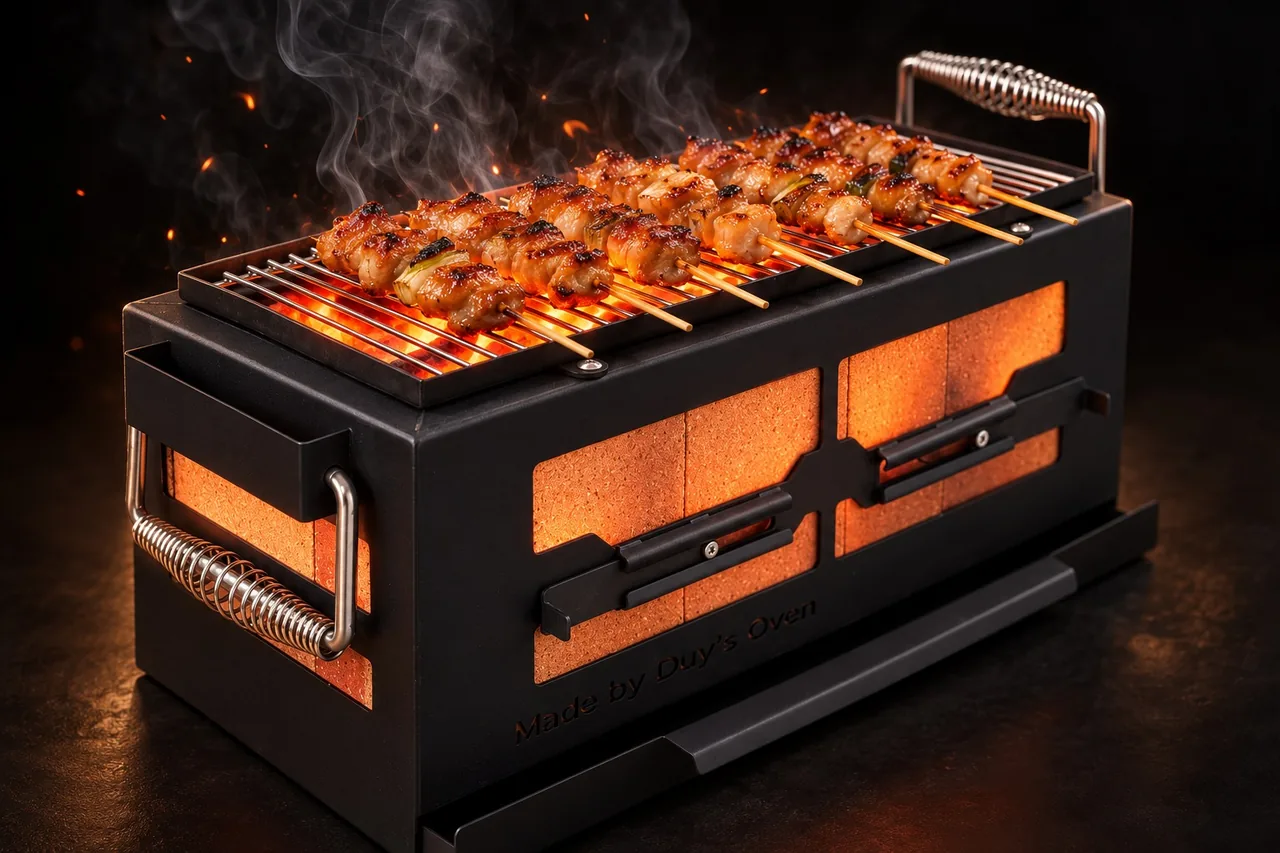
The Duy's Oven Yakitori grill (konro) is built the Japanese way: a sturdy steel body lined with thick heat-resistant brick. Once the brick heats up it throws infrared heat evenly onto both sides of the skewers, so the charcoal burns steadily and the meat is less likely to scorch. It burns binchotan, and its long shape holds a whole row of skewers — the meat cooks evenly, crisp outside and juicy inside. Two versions: black body in heat-resistant paint and stainless steel body, sizes made to order.
A 3D simulation that looks through the grill body: first the Yakitori grill with an ash tray, then the Smoke-Reducing version with a grease tray and a double-layer lid.
Yakitori Grill
Use binchotan (white charcoal) or lump charcoal, spread out over the brick floor. The tabletop Mini needs only five or six pieces.
Let the charcoal glow red all over before you grill; never light it with petrol or oil.
Slide the air vents on the body: open them wider for hotter coals, close them for a gentler fire. The air slots in the brick wall feed extra oxygen so the charcoal burns out fully with little smoke.
Rest the skewers across the mouth of the grill, or set a wire grate for larger cuts. Keep turning the skewers so the meat sears evenly.
After grilling, leave the grill where it is until it is completely cool. The brick holds heat for a long time; never pour water on the bricks while the grill is hot.
Grills from 54 cm have an ash tray: pull out the steel plate in the middle of the floor, rake the ash down into the tray, then slide the tray out and empty it. Smaller grills have no ash tray: wait until the grill is completely cool, then scoop the ash out.
Smoke-Reducing Yakitori
The charcoal sits on the brick floor, under the grease tray and right above the ash tray. Lay it and let it glow red all over; never light it with petrol or oil.
The grease tray sits right under the grate, between the meat and the charcoal; long slots in the tray let the heat rise. One tray covers half the grill for half-grill cooking; add a second and the whole grill is covered.
The stainless grate fits two ways: as normal, or taken out and turned over so it sits low and the heat wraps the whole piece of meat. Without the grate, rest skewers yakitori-style.
Slide the air vents on the body to control the fire. The ash tray at the bottom is also an air inlet.
With the lid open, grill skewers and keep turning them. Close the double-layer lid to hold the heat for ribs, chicken thighs or fish; the thermometer on the lid shows how hot the grill is. The lid comes off, but flipping it up is enough.
After grilling, wait for the ash to cool, pull out the steel plate in the floor, rake the ash down into the tray, then slide the tray out and empty it.
Safety: burning charcoal gives off CO, so only grill in a well-ventilated place. Carry the grill by its two handles, and only once it has cooled.
A normal konro has no ash tray and nowhere to rake the ash down. Duy's Oven replaces one floor brick with a steel plate: slide it out, the floor opens, rake the ash down and pull out the tray (sizes 54 cm and up). Duy also shows the smoke-reducing yakitori: a removable double-wall lid, a grease shield that limits smoke, and a grate that flips to two heights.
Burning charcoal gives off carbon monoxide: grill only in a well-ventilated place.
More than just a long grill — the konro cooks with radiant heat from glowing charcoal, while the heat-resistant brick lining heats up and throws that heat evenly onto both sides of the skewers, so the coals burn steadily and the meat cooks evenly and stays juicy.
The heat-resistant brick lining heats up and throws infrared heat evenly onto both sides of the skewers: the charcoal burns steadily and the meat cooks through with less scorching.
Glowing charcoal is a solid mass heated red, so it radiates heat continuously, quite unlike a gas flame. Binchotan burns hot, steady and long, and leaves little ash, so the surface of the meat browns evenly while the inside stays juicy.
Long narrow grill channel for stacking yakitori skewers closely — fast cooking, high output, matches professional restaurant pace.
A Japanese konro carved from a single block of diatomaceous earth cracks easily; the Duy's Oven version is a steel frame lined with heat-resistant brick — durable, impact-resistant, and built for long-term commercial use.
Black steel body in heat-resistant paint or bright stainless steel body resistant to rust — choose according to your restaurant style and usage conditions.
Made in 8 standard Japanese sizes (from 27cm for tabletop to 120cm for large kitchens) or customize to fit snugly into your kitchen counter.
Drag the "Air / charcoal amount" slider to watch the binchotan glow, the radiant heat build, and the skewers turn golden; the heat-resistant brick walls heat up and throw heat evenly onto both sides of the skewers. Tap to switch between skewers and the wire grate.
Japanese konro comes in two size groups: narrow long form (23cm wide) for tightly packed skewers in yakitori restaurants, and wide form (35cm) for wire racks and trays. Duy's Oven makes custom sizes to fit your kitchen counter.
All eight sizes are in stock at the Duy's Oven workshop in Nha Be; sizes from 54 cm up have a pull-out ash tray, plus a steel plate in the middle of the floor that slides out so you can rake the ash down into the tray. The four small sizes are the four grills in the real photos below.
| Size | Length × Width × Height | Category | Ideal for | Price (incl. 10% VAT) |
|---|---|---|---|---|
| Mini tabletop | 27 × 17 × 19 cmInside 20,6 × 10,6 × 15,8 cm | Narrow elongated | 1–2 people, tabletop grilling | 2.750.000₫ |
| Small | 31 × 23 × 23 cmInside 24,6 × 16,6 × 19,8 cm | Wide | Family | 3.850.000₫ |
| Medium square | 46 × 35 × 23 cmInside 39,6 × 28,6 × 19,8 cm | Wide | Tray cooking, large family | 4.950.000₫ |
| Medium elongated With ash tray | 54 × 23 × 23 cmInside 47,6 × 16,6 × 19,8 cm | Narrow elongated | Small restaurant, many skewers | 6.050.000₫ |
| Large wide With ash tray | 70 × 35 × 23 cmInside 63,6 × 28,6 × 19,8 cm | Wide | Restaurant | 8.800.000₫ |
| Large elongated With ash tray | 77 × 23 × 23 cmInside 70,6 × 16,6 × 19,8 cm | Narrow elongated | Yakitori restaurant, packed skewers | 8.250.000₫ |
| Extra large With ash tray | 92 × 35 × 23 cmInside 85,6 × 28,6 × 19,8 cm | Wide | High-capacity kitchen | 13.750.000₫ |
| Super extra large With ash tray | 120 × 35 × 23 cmInside 113,6 × 28,6 × 19,8 cm | Wide | Large parties, industrial kitchen | 17.050.000₫ |
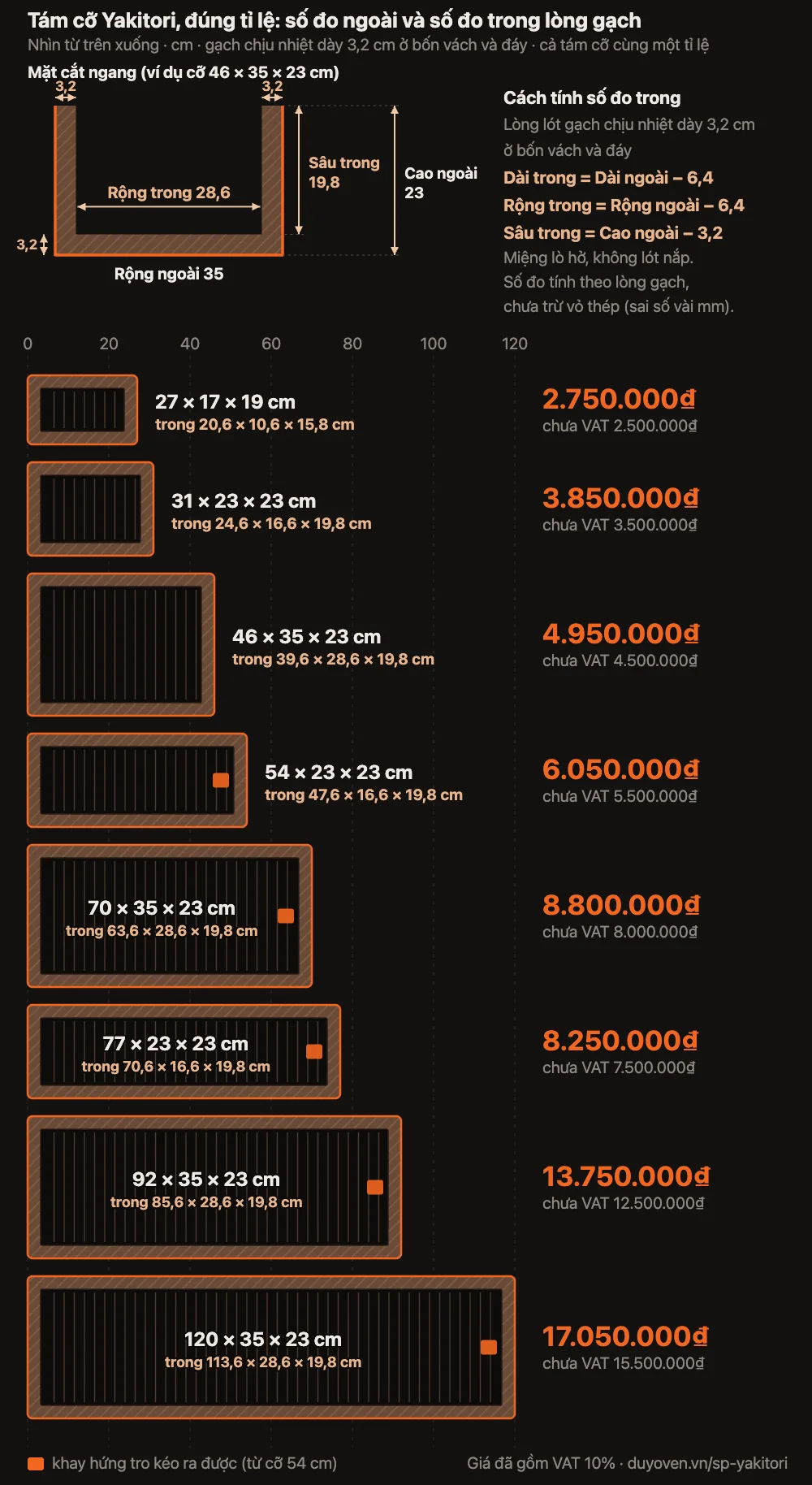
Exterior dimensions (Length × Width × Height). Other sizes available on request — tell us your counter measurements. Prices in the table include 10% VAT, from 2,750,000₫ to 17,050,000₫. The stainless steel version is priced separately.
Interior dimensions are the measurements inside the brick. The grill interior is lined with 3.2 cm thick heat-resistant brick on all four walls and the floor, so the interior equals the exterior minus 6.4 cm in length, 6.4 cm in width, and 3.2 cm in height. Measurements are based on the brick chamber, not accounting for the steel shell, with a margin of error of a few mm.
These four konro grills just came out of the Duy's Oven workshop in Nha Be. The black steel body has window cut-outs that show the heat-resistant brick inside, each side has a sliding air vent to adjust the fire, and both ends carry stainless steel spring-wrapped handles.
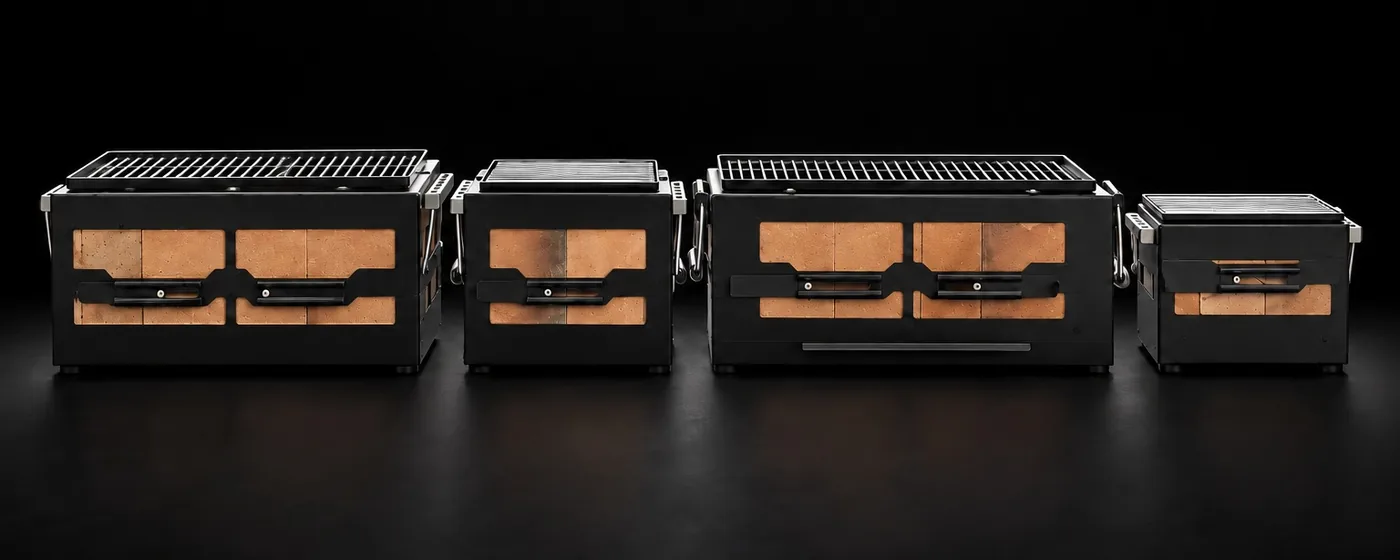
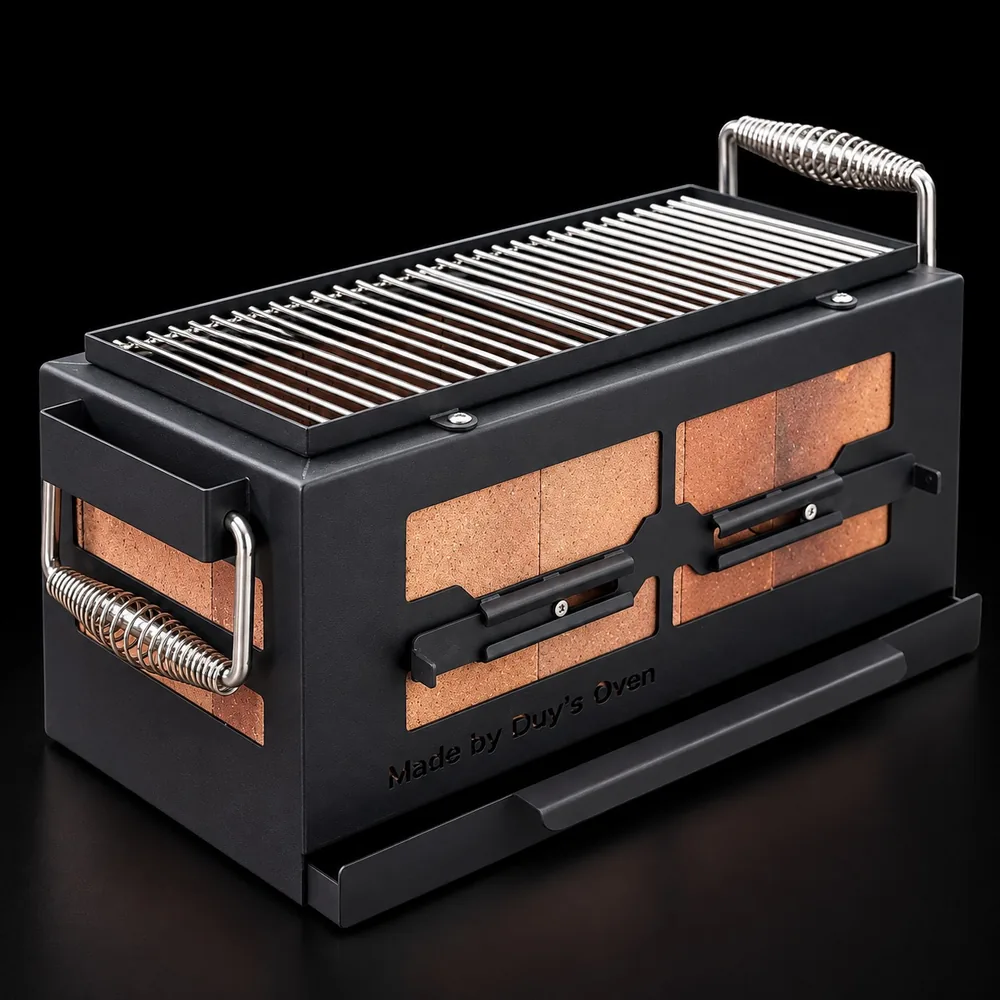
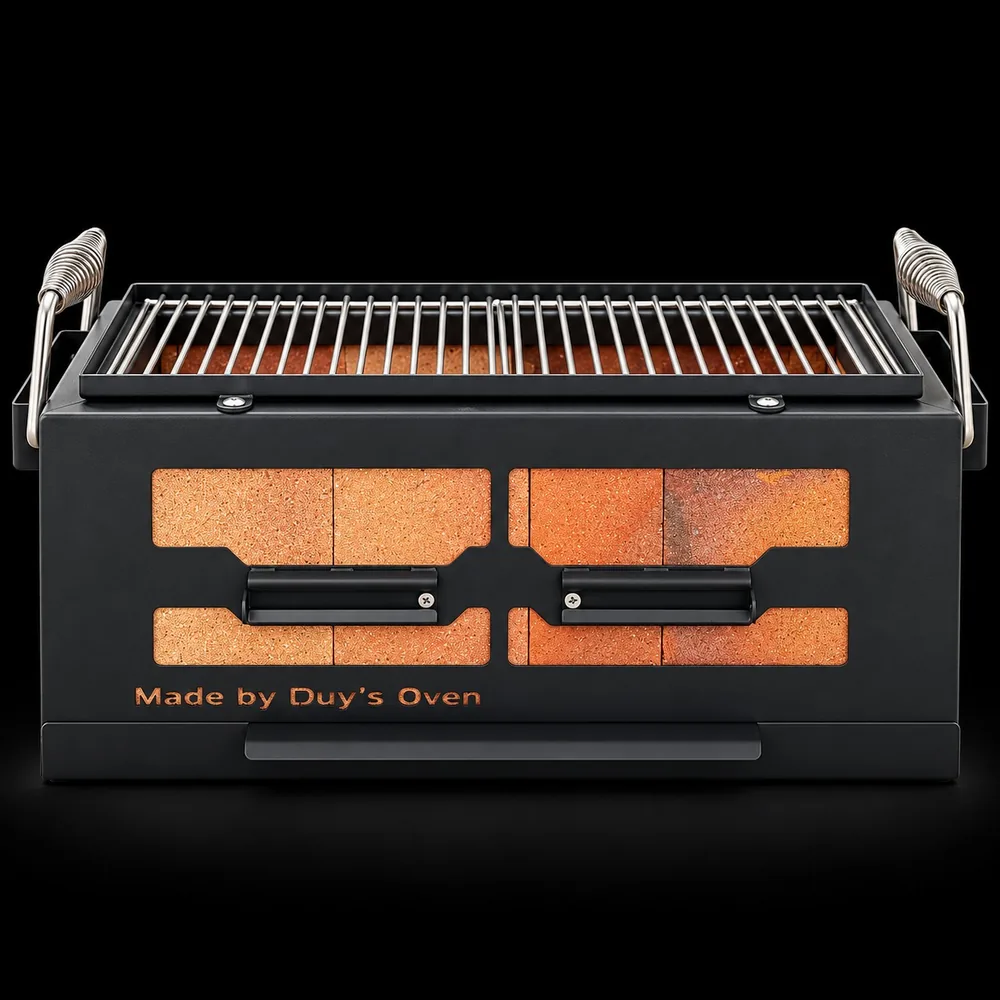
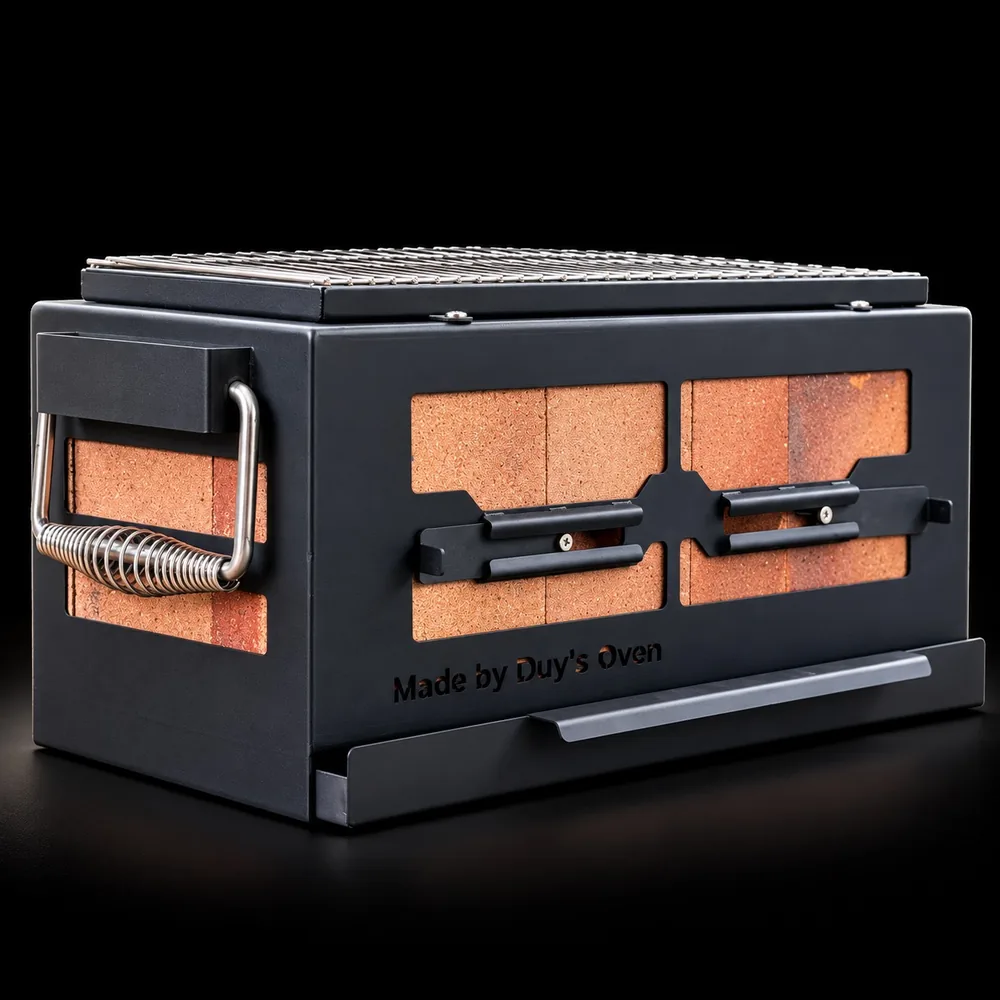
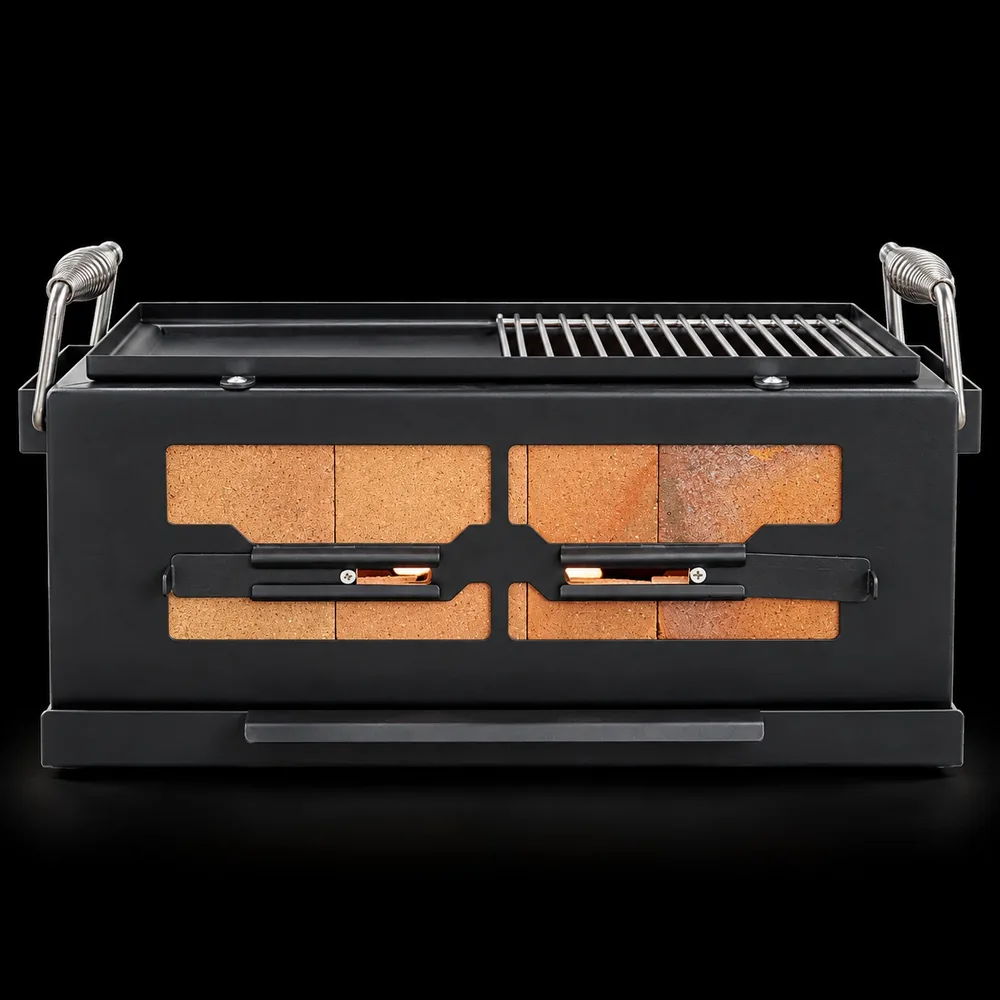
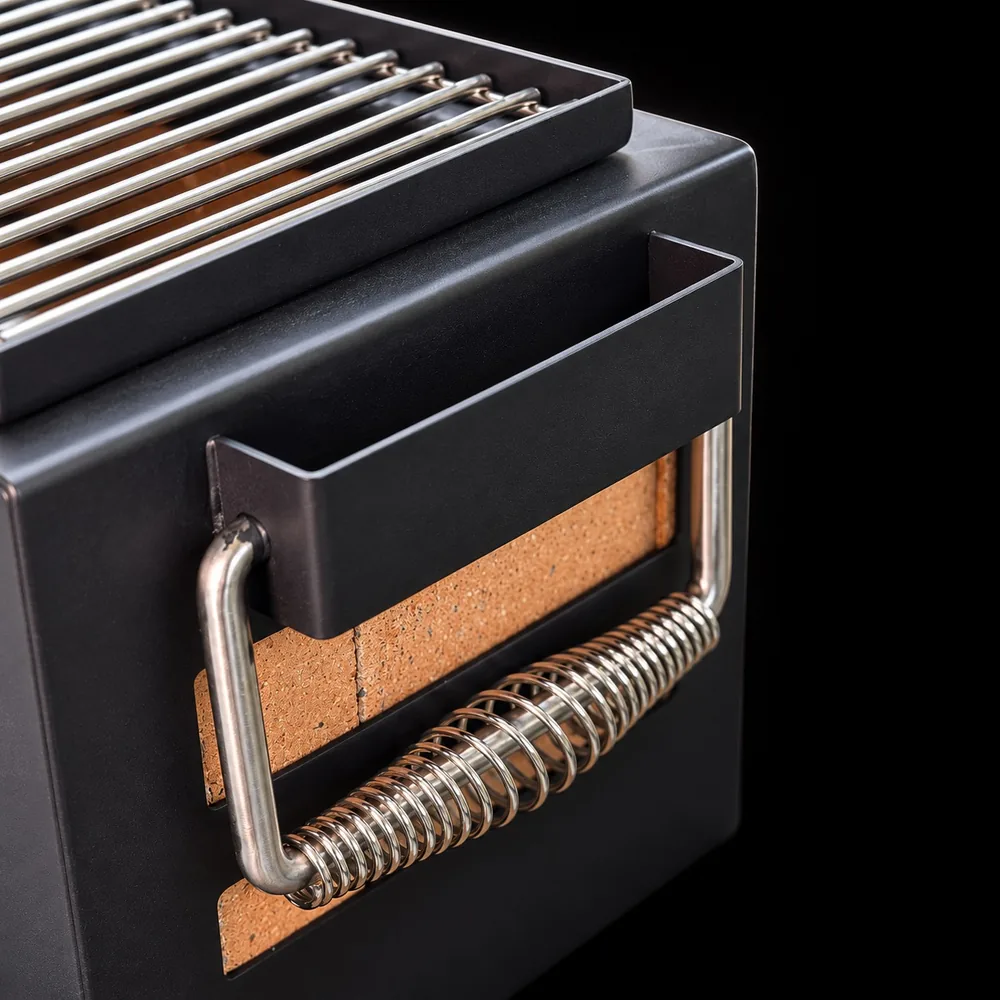
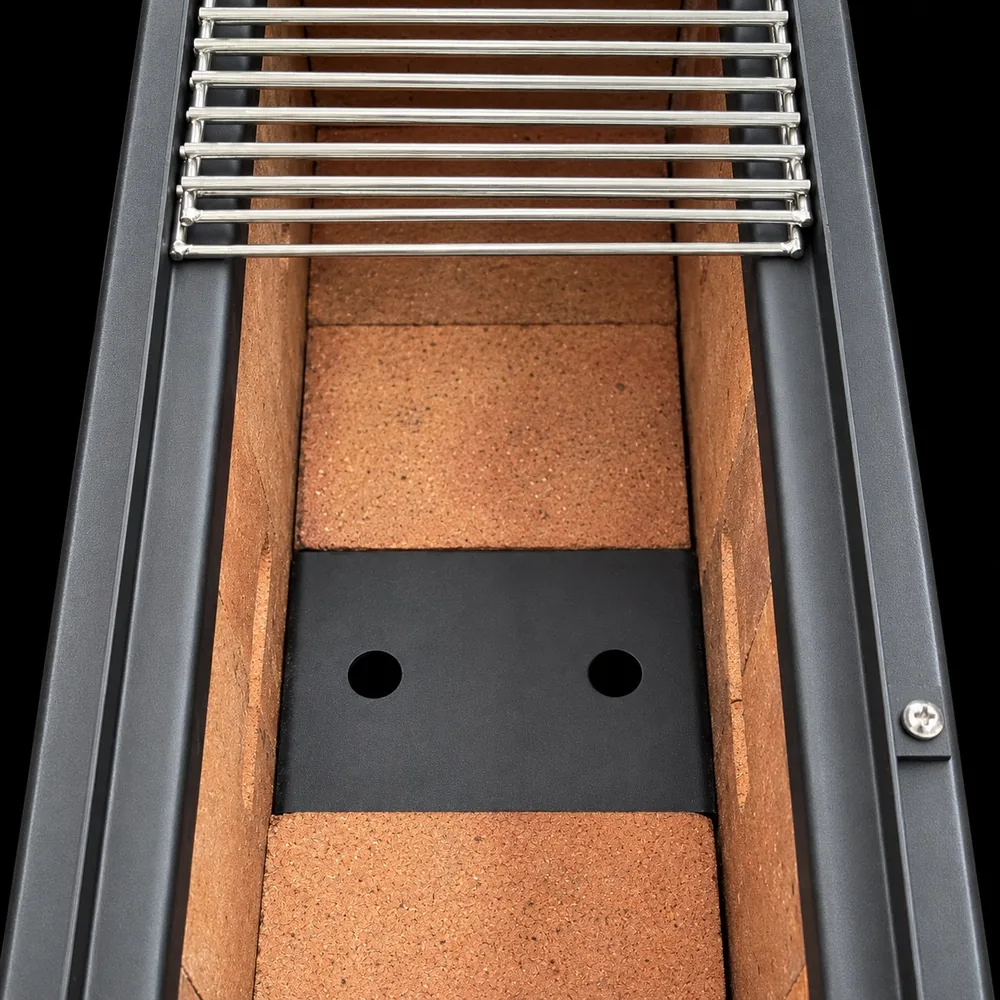
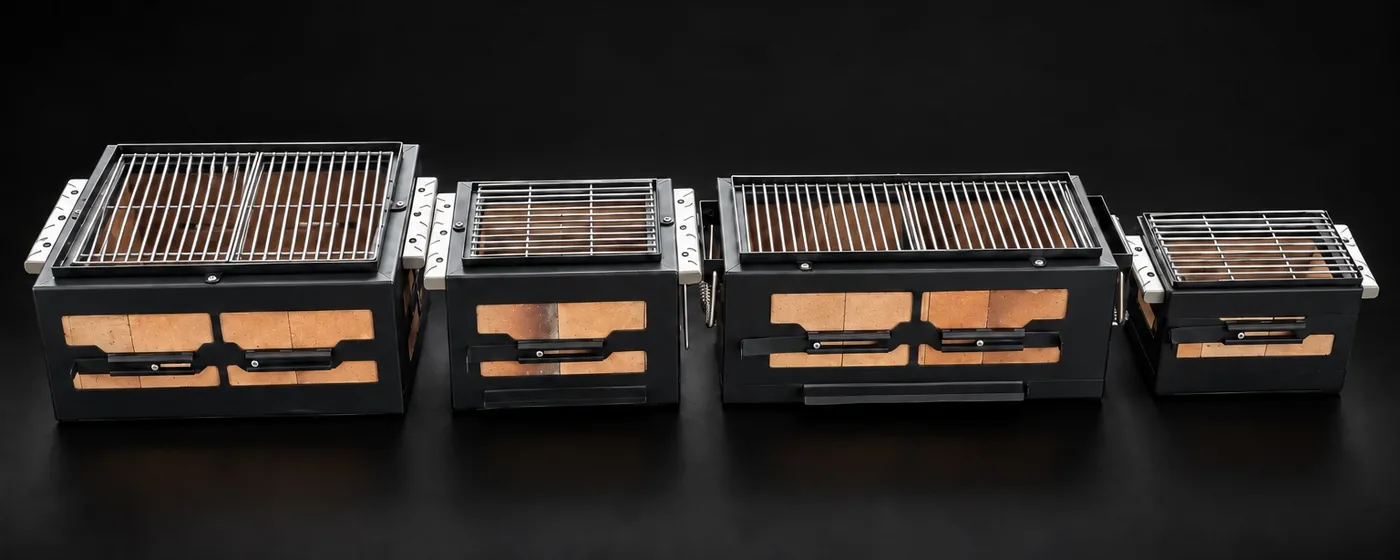
The windowed yakitori grill: a sliding air vent on each side to control the fire, and a steel plate in the floor that pulls out so you can rake the ash down into the tray (sizes 54 cm and up). Eight sizes in stock, from 27 to 120 cm.
Burning charcoal gives off carbon monoxide: grill only in a well-ventilated place.
The size-70 Yakitori (70 × 35 × 23 cm, roughly 50 kg by Duy's estimate): ash tray, air vents at the front and the back, handle, and grates made to order.
Burning charcoal gives off carbon monoxide: grill only in a well-ventilated place.
The size-46 Yakitori (46 × 35 × 23 cm): a wide, almost square grilling area. Scatter the coals; the firebrick soaks up heat and throws it back up at the grate, and air slots in the brick wall feed oxygen so the fire burns once more above the coals, cutting down smoke. The Mini (27 × 17 × 19 cm) nests inside it.
Burning charcoal gives off carbon monoxide: grill only in a well-ventilated place.
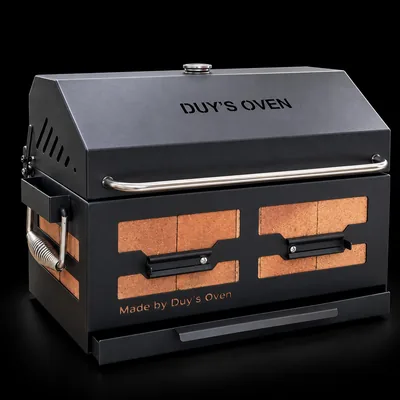
The Smoke-Reducing Yakitori Grill adds a stainless steel grease tray so fat doesn't drip straight onto the charcoal, plus a double-layer insulated lid and a pull-out ash tray. With the lid open you grill skewers; with the lid closed it cooks like a Pantina smoke-reducing grill.
Open the Smoke-Reducing Yakitori tab →Want an extra rack tier? The Plus version has two four-notch lift posts and a hanging grill-rack frame: close the lid to grill like the Smoke-Reducing version, or remove the lid to grill on two-tier racks.
Open the Smoke-Reducing Plus tab →One konro — endless possibilities: professional yakitori restaurant counter, cozy izakaya table, backyard BBQ party, or dinner grilled right at your table.


The gleaming stainless steel version for shops that want a modern look; seen from above is the heat-resistant brick interior — the heart of the grill, where heat is thrown evenly onto the skewers.


| Model | Yakitori Grill (Konro) — Duy's Oven |
|---|---|
| Grill type | Japanese Konro (yakitori · hibachi) |
| Grill interior | Heat-resistant brick heats up and throws infrared evenly onto both sides of the skewers |
| Frame / body | Steel with heat-resistant paint (black) or stainless steel |
| Fuel | Binchotan (white charcoal) / charcoal |
| Cooking surface | Stack skewers directly on grill opening + steel mesh grate |
| Dimensions | 8 standard sizes 27–120cm (Length × Width × Height) or made to order |
| Interior dimensions | 3.2 cm thick heat-resistant brick lining on all four walls and the floor: interior equals exterior minus 6.4 cm in length, 6.4 cm in width, and 3.2 cm in height (size 46 × 35 × 23 has an interior of 39.6 × 28.6 × 19.8 cm) |
| In stock | All 8 sizes in the Choose size table · ash tray on sizes from 54 cm up |
| Origin | Made in Vietnam (Ho Chi Minh City) |
| Ideal for | Yakitori restaurant · izakaya · Japanese restaurant · backyard BBQ |
| Price | From 2.750.000₫ incl. 10% VAT — see the Choose size table for each size's price |
The long read over at BBQ LAB names the fourteen cuts of the chicken, explains how the Japanese fire white binchotan charcoal in kilns to the standard of the Japan Fuel Association, covers the diatomite konro grills of Suzu, and says plainly where sellers tend to overstate the infrared claims.
Read What is Yakitori →Konro built in our Ho Chi Minh City workshop — heat-resistant brick interior, durable steel frame, made to fit your kitchen counter. Contact us for advice and a size-based quote.
Contact us now — 0901 691 717 Chat on ZaloThe Smoke-Reducing Yakitori Grill starts from the Yakitori grill body; the Duy's Oven workshop in Nha Be then adds a stainless steel grease tray inside the chamber and gives it a double-layer lid. Fat dripping from the meat falls onto the tray instead of straight onto the charcoal, so flare-ups are rare and grilling smoke drops sharply. The chamber is lined with heat-resistant brick, the double-layer lid holds heat like a brick wall, and the ash tray at the bottom slides out for easy emptying.
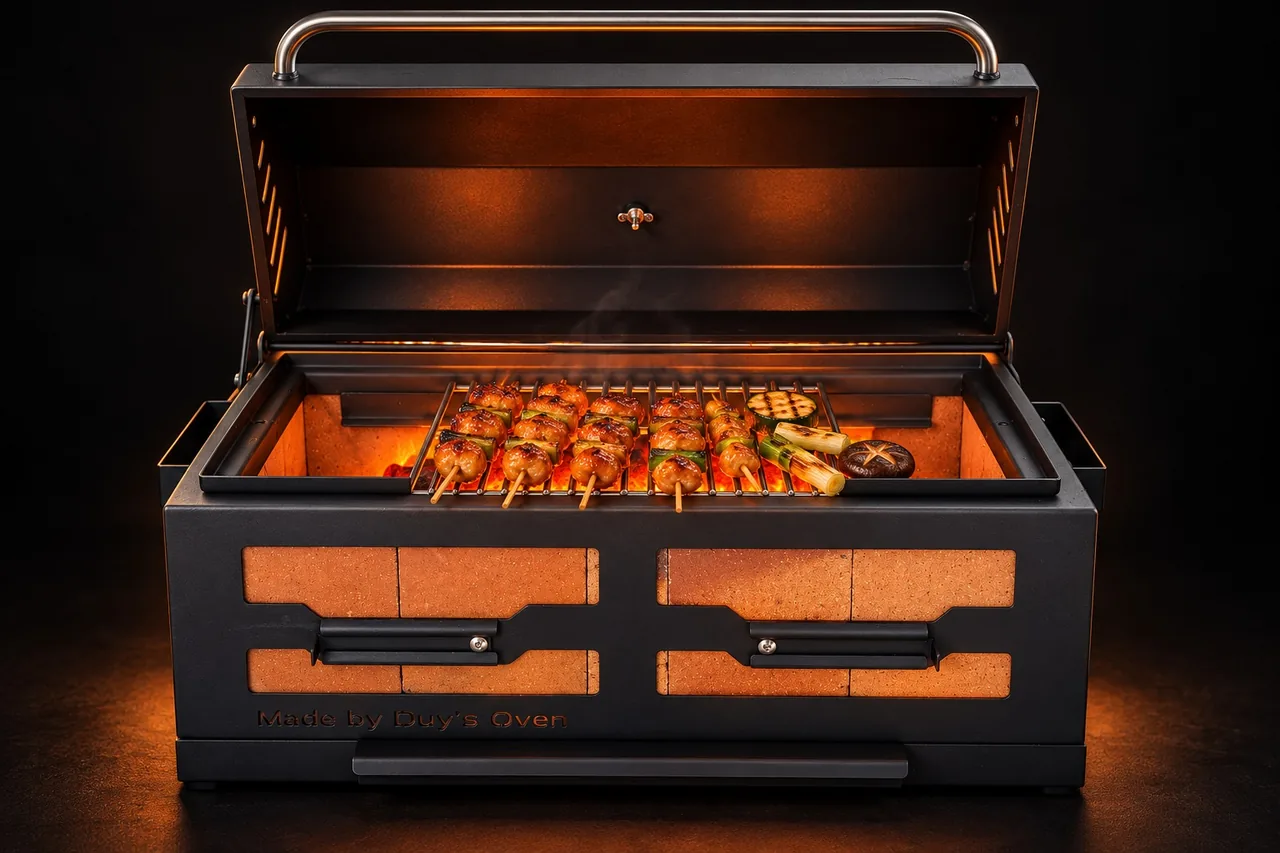
This grill doesn't make you pick one way of cooking. When you want fast skewer grilling like a yakitori counter, open the lid; when you have a thick cut that needs to cook evenly, close the lid and cook, just as you would on a Pantina smoke-reducing charcoal grill. Lid open or closed, the grease tray stays in place to catch the dripping fat for you.
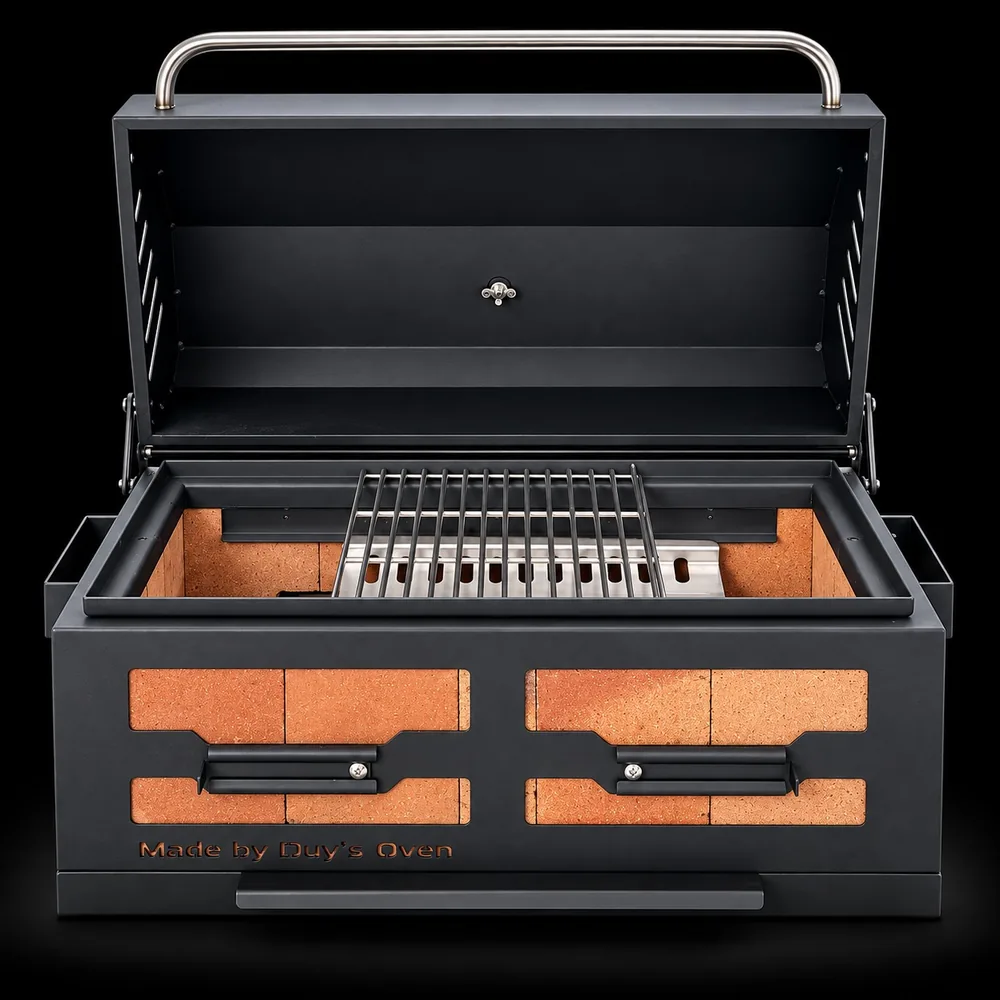
The charcoal burns steadily inside the brick chamber, and the grate sits low so the heat rises straight onto the meat. You line the skewers up on the grate and keep turning them; the surface sears and the edges char just right, like at a Japanese grill counter, while the grease tray catches the fat that drips down.
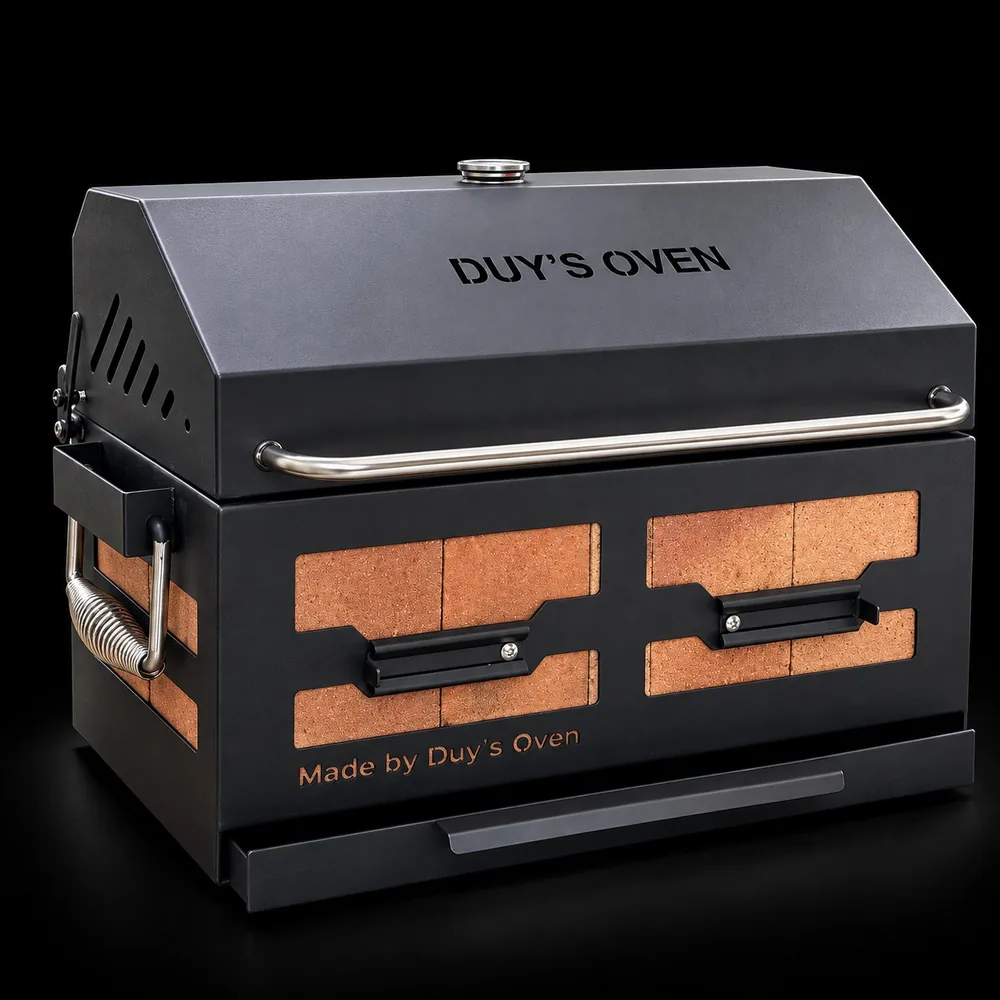
When you close the double-layer lid, heat from the charcoal and the brick walls stays inside the chamber and wraps around the meat. Ribs, chicken thighs, fish or vegetables cook evenly and stay juicy, and grilling smoke drops sharply because most of the fat has fallen onto the grease tray instead of straight onto the charcoal. A glance at the thermometer on the lid tells you how hot the grill is.
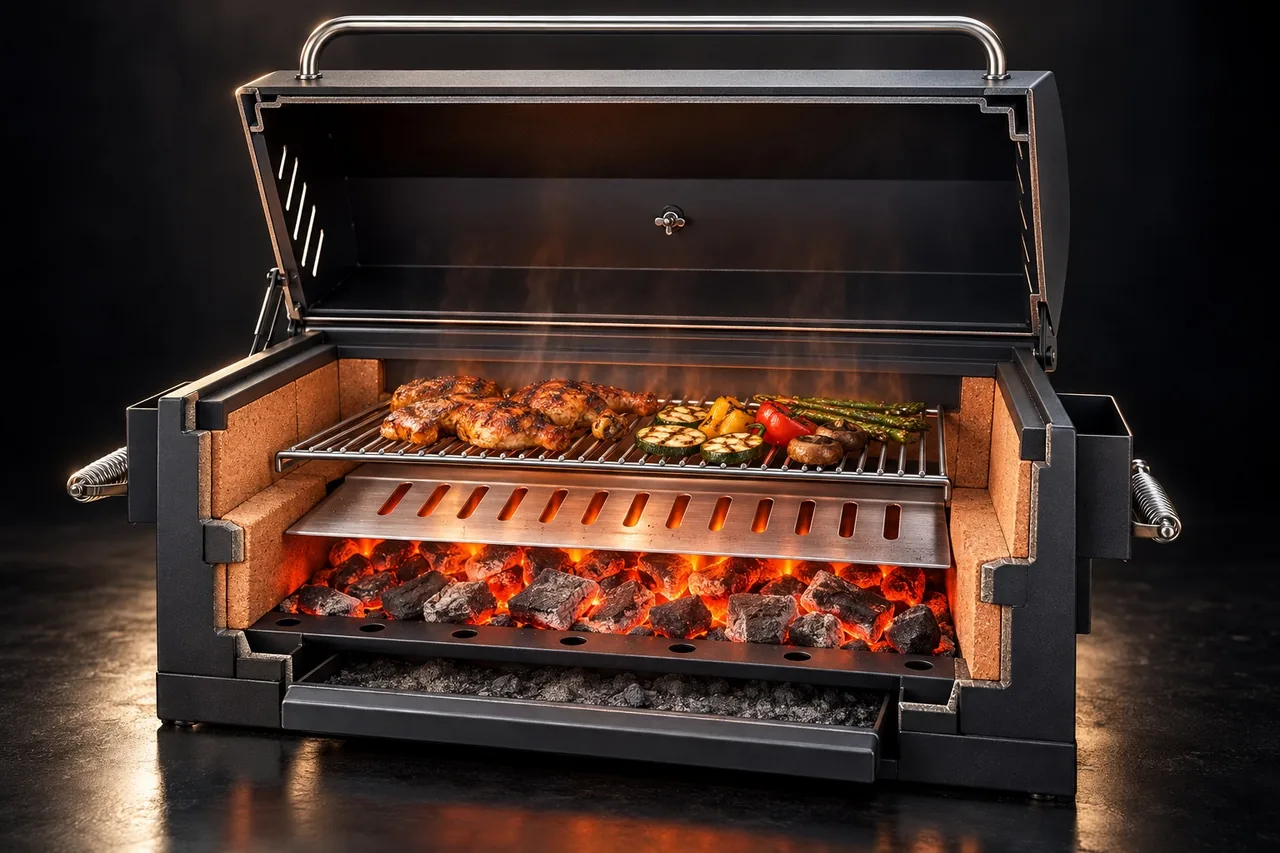
The smoke-reducing design of this grill comes down to the order of the layers inside. At the very bottom is the pull-out ash tray, the charcoal sits in the brick chamber just above it, and you control the airflow with the sliding air vents on the body. Above the charcoal, right under the grate, the workshop places a stainless steel grease shield; it has a row of long slots that let the heat rise, while the solid steel catches the fat. The cooking grate sits right on top of the shield, set deep below the rim of the grill.
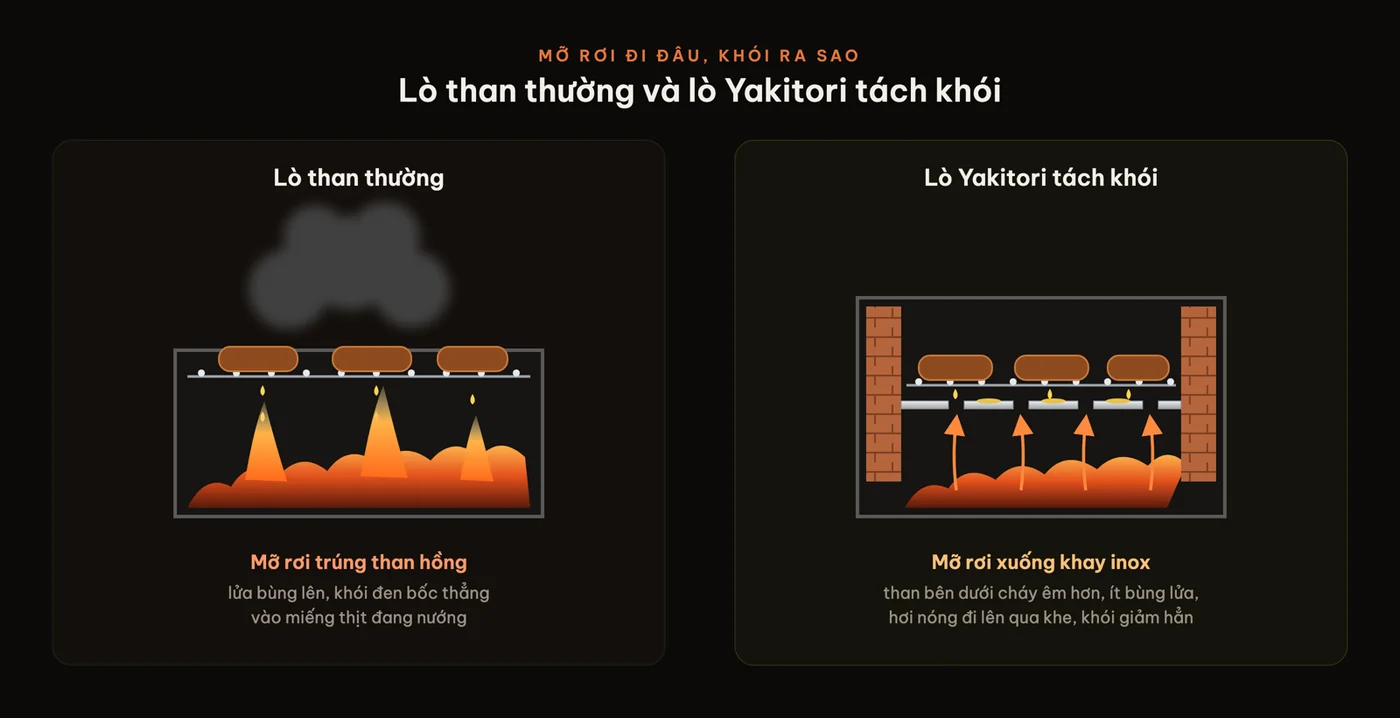
On an ordinary charcoal grill, fat hitting the glowing coals flares up, and black smoke rises, clings to the meat and gives it a burnt smell. Here most of the fat falls onto the stainless steel tray instead of straight onto the hot coals, so the charcoal below burns more calmly, and what rises through the slots is mostly the charcoal's heat. The meat keeps the charcoal aroma with far less greasy smoke on it.
The deep-set grate is something the workshop worked out carefully. When the meat sits low in the brick chamber, it takes heat from the charcoal below and from the hot brick walls around it; with the lid closed, a layer of heat also builds up above. Heat surrounding the meat like this creates a well-balanced cooking zone, so the meat cooks more evenly and you don't have to keep flipping it back and forth.
The workshop builds the lid with two layers so heat has a hard time escaping, and it holds heat much like the heat-resistant brick lining the chamber. With the lid and the brick both holding heat, the chamber heats more evenly when the lid is closed, and the heat stays in the grill for a long time.
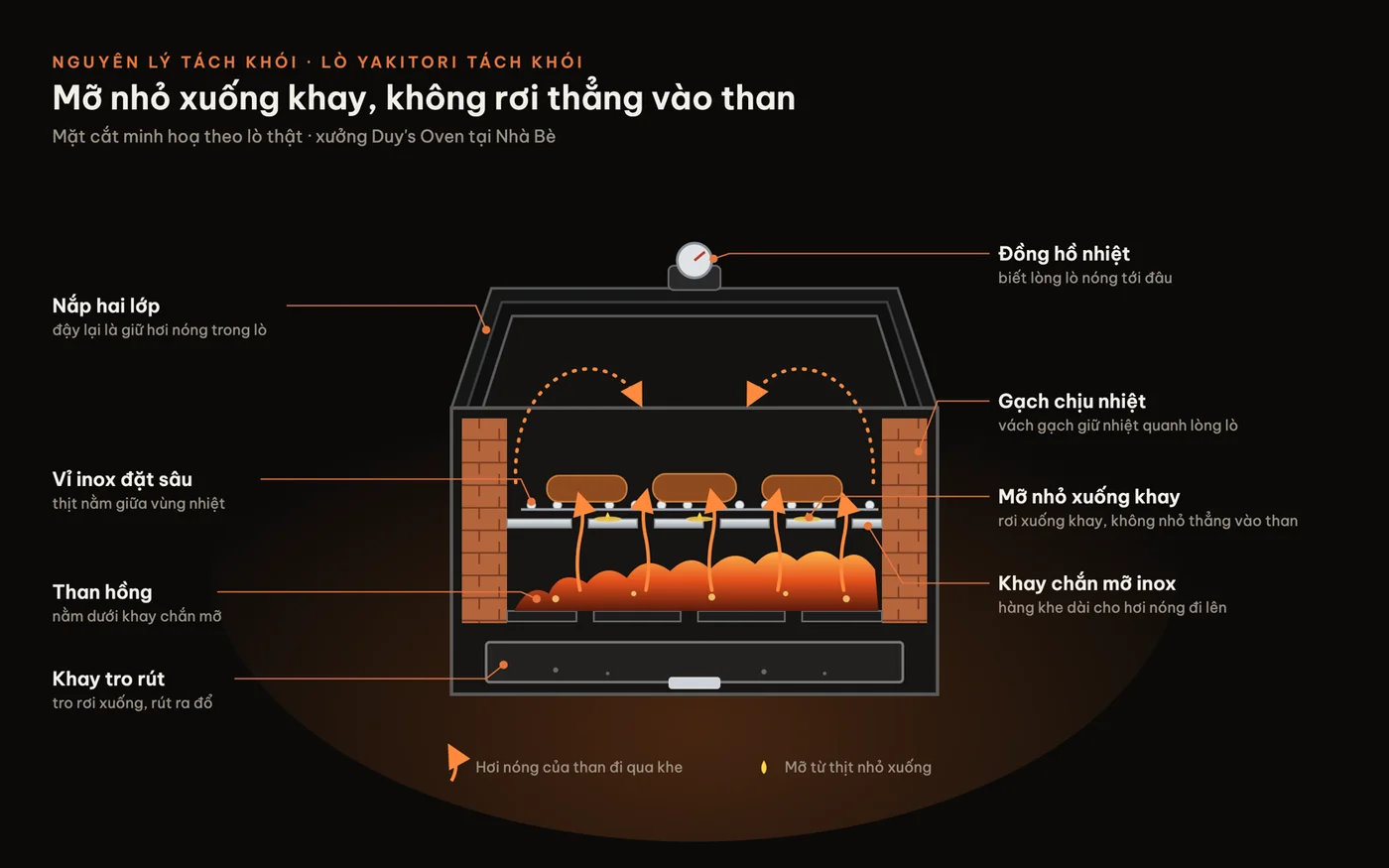
The stainless grease tray sits between the grate and the charcoal: fat drips onto the tray instead of straight onto the coals, so there are fewer flare-ups and far less smoke. The double-layer lid only holds the heat. The Smoke-Reducing version is in the second half of the clip.
The charcoal sits on the brick floor, under the grease tray and right above the ash tray. Lay it and let it glow red all over; never light it with petrol or oil.
The grease tray sits right under the grate, between the meat and the charcoal; long slots in the tray let the heat rise. One tray covers half the grill for half-grill cooking; add a second and the whole grill is covered.
The stainless grate fits two ways: as normal, or taken out and turned over so it sits low and the heat wraps the whole piece of meat. Without the grate, rest skewers yakitori-style.
Slide the air vents on the body to control the fire. The ash tray at the bottom is also an air inlet.
With the lid open, grill skewers and keep turning them. Close the double-layer lid to hold the heat for ribs, chicken thighs or fish; the thermometer on the lid shows how hot the grill is. The lid comes off, but flipping it up is enough.
After grilling, wait for the ash to cool, pull out the steel plate in the floor, rake the ash down into the tray, then slide the tray out and empty it.
Safety: burning charcoal gives off CO, so only grill in a well-ventilated place. The grill weighs 45 kg: carry it by its two handles, and only once it has cooled.
Duy explains how the Vietnamese version differs from a Japanese konro: a grease tray between the grate and the charcoal, a pull-out ash tray at the bottom, a brick chamber that soaks up heat and radiates infrared onto the meat, and a grill that can sit out in the rain without trouble.
Burning charcoal gives off carbon monoxide: grill only in a well-ventilated place.
Cut from real footage of the grill, plus a 3D cross-section simulation that shows fat landing on the stainless-steel shield and heat rising through the long slots on both sides. The voice is an AI imitation of Duy's voice. The grill is 60 cm long, 30 cm wide and 40 cm tall.
Burning charcoal gives off carbon monoxide: grill only in a well-ventilated place.
Fat drips onto the tray instead of straight onto the charcoal, so there are fewer flare-ups, far less smoke and less burnt smell on the meat.
The meat sits between the charcoal below and the hot brick walls around it; heat surrounds it so it cooks evenly and stays juicy.
The chamber is lined with heat-resistant brick like the Yakitori line, holding heat so the charcoal burns steadily through the whole session.
Closing the lid keeps the heat inside, and a quick look at the thermometer on the lid tells you how hot the grill is.
When you're done, rake the ash down into the tray at the bottom, then slide the tray out and empty it.
The body is steel in black heat-resistant paint with window cut-outs that show the brick inside, and the handles are stainless steel wrapped in springs. The grill is handcrafted, combined with modern laser cutting and welding, with finely finished details, so it looks right in a backyard or on a restaurant counter.
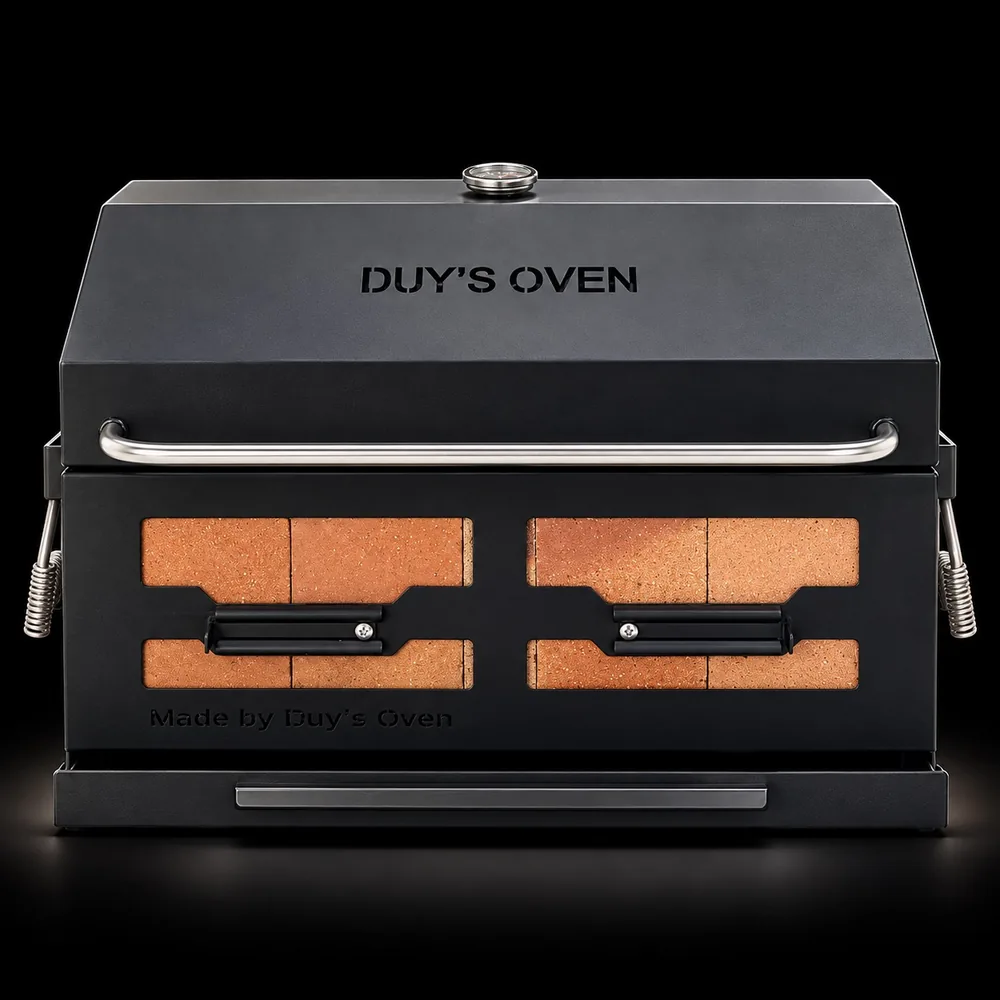
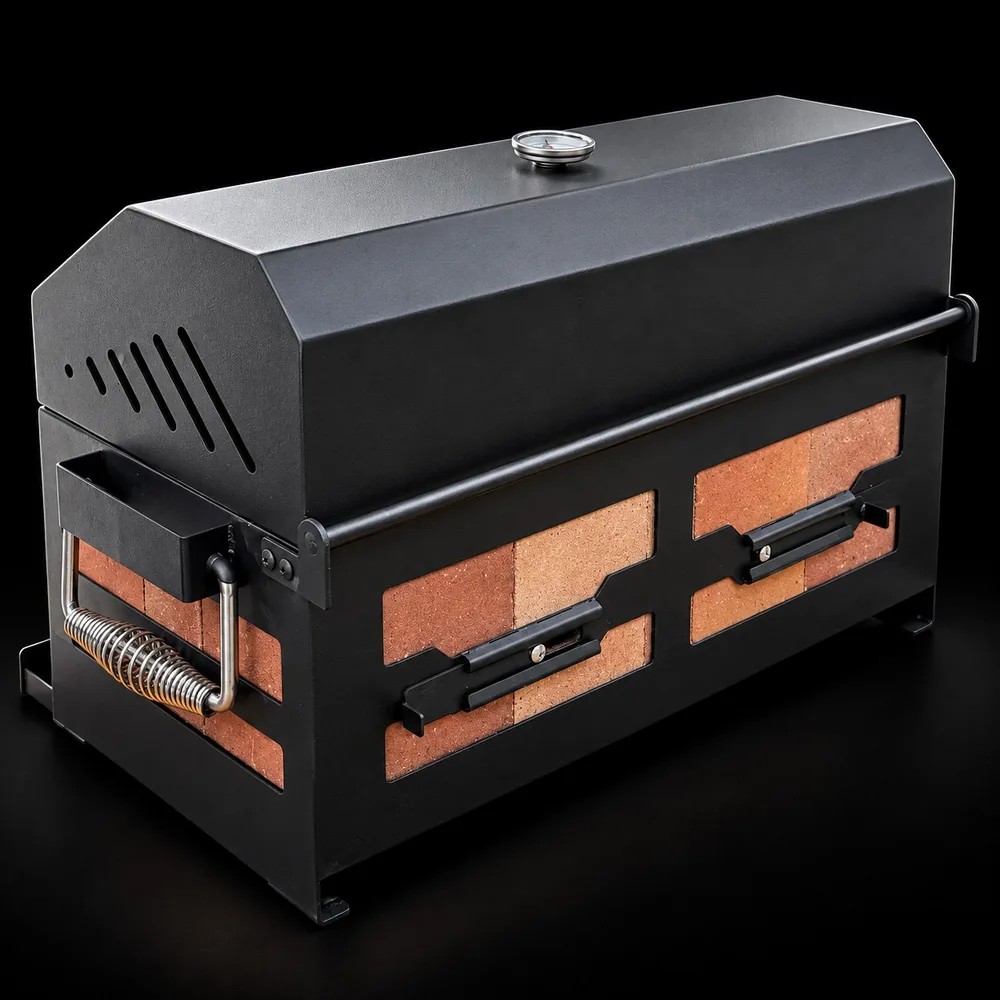
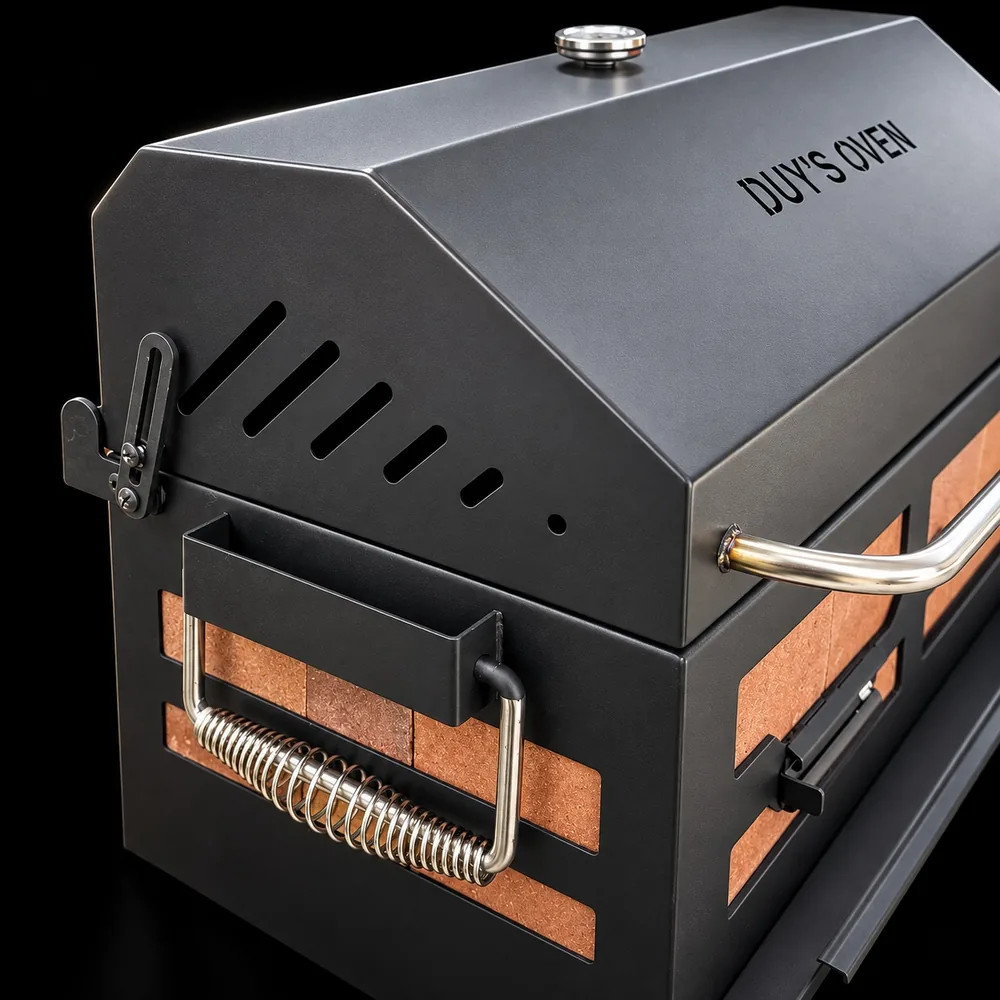
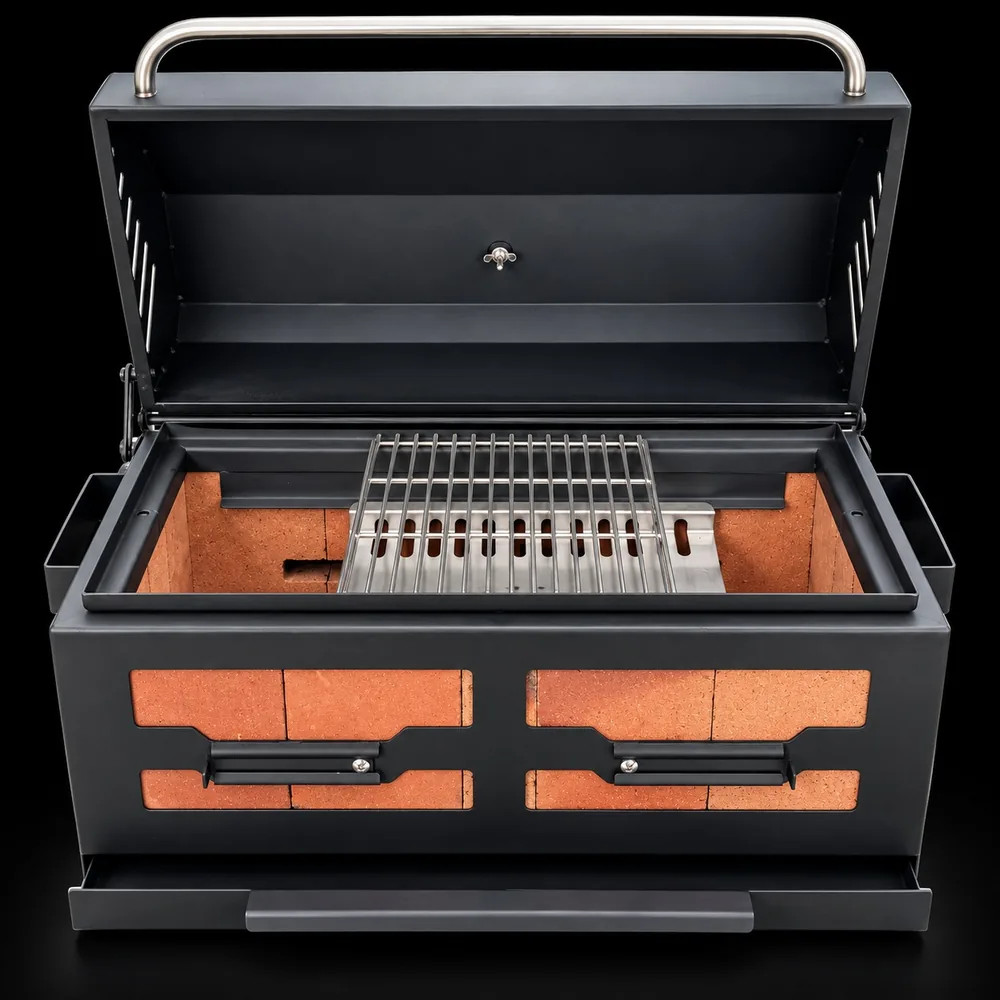
At home, the grill fits on a garden table or out on the balcony, enough for a whole-family barbecue. In a restaurant, it sits neatly on the counter: lid open to grill skewers for counter guests, lid closed for larger dishes that need to cook evenly. At 45 kg it stands firm, and the handles at both ends let you carry it when needed.
| Model | Smoke-Reducing Yakitori Grill · Duy's Oven |
|---|---|
| Line | Yakitori, smoke-reducing version |
| Dimensions | 60 × 30 × 40 cm (L × W × H) |
| Weight | 45 kg |
| Oven body | Steel in black heat-resistant paint with window cut-outs showing the brick |
| Grill interior | Heat-resistant brick |
| Lid | Double-layer, with thermometer, stainless steel handle and steam vent |
| Smoke-Reducing | Stainless steel grease tray with heat-guiding slots |
| Grill grate | Stainless steel, set deep in the chamber |
| Ash tray | Yes, pulls out at the bottom |
| Air vents | Sliding air vents on the body to adjust the fire |
| Fuel | Binchotan or regular charcoal |
| How to use | Lid open for Yakitori-style skewers · lid closed to cook like a Pantina smoke-reducing grill |
| Ideal for | Homes · restaurants · grill houses |
| Origin | Duy's Oven workshop in Nha Be |
| Warranty | 12 months |
| Price | 9.680.000₫ VAT included |
The Plus version has two four-notch lift posts and a hanging grill-rack frame: close the lid to grill like the Smoke-Reducing version, or remove the lid to grill on two-tier racks.
Open the Smoke-Reducing Plus tab →The original Yakitori Grill line has eight sizes in stock, from the 27 cm tabletop model to the 120 cm one for large kitchens, with a heat-resistant brick-lined chamber that burns binchotan charcoal.
Open the Yakitori Grill tab →Drop by the Duy's Oven workshop in Nha Be or message us, and we'll show you how to use it and give you a quote.
Contact us now: 0901 691 717 Chat on ZaloThe Smoke-Reducing Yakitori Grill Plus builds on the grill of the Smoke-Reducing version: a stainless steel grease tray, a double-layer lid, and a grate set deep in the heat-resistant brick chamber. The Plus version adds two steel lift posts standing at the two rear corners behind the grill, each with four notches, along with a hanging grill-rack frame that hooks into the notches. Hook the frame on a low notch and the grill gains an extra rack tier right above the main grate. Hook the frame on a high notch and the lid still closes, while the grill-rack frame sits above the lid as a resting spot for meat after grilling.
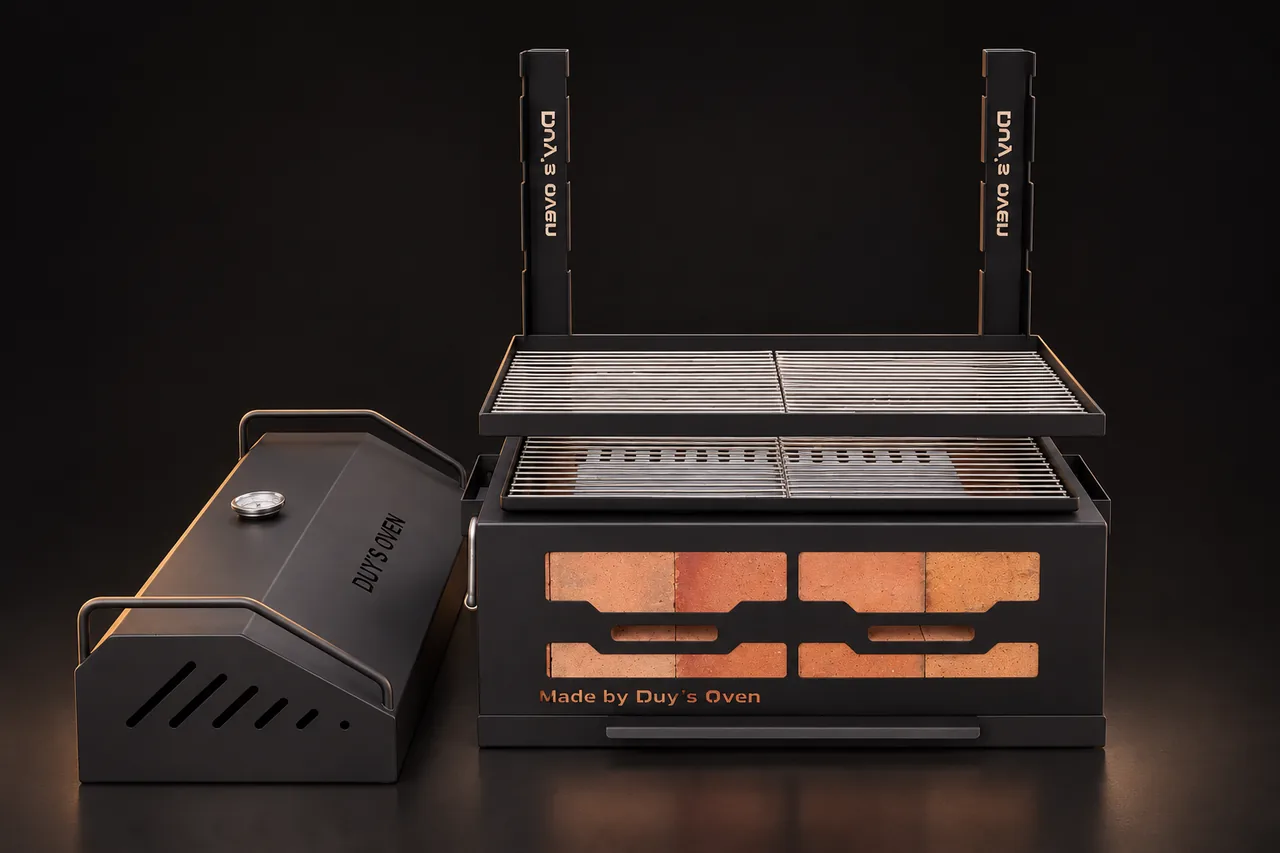
The two lift posts stand at the two rear corners behind the grill. Our workshop laser-cuts each post from 1.4 mm steel sheet and bends it into a U-channel. Along the face of the post, DUY'S OVEN is cut right through the steel. Each edge of the post has four hooking notches spaced 10 cm apart, and the mouth of each notch has a small lip that keeps the grill-rack frame from slipping out.
To change the height, lift the grill-rack frame and hook it onto another notch. The grill has no crank or lever, so raising and lowering it is very simple. From the lowest notch to the highest notch, the grill-rack frame travels 30 cm.
The lift posts are removable. Each post bolts onto a rear corner of the grill body with two bolts, using pre-drilled bolt holes. For delivery, our workshop removes both posts to keep the package compact; once it arrives home, you simply bolt them back into place.
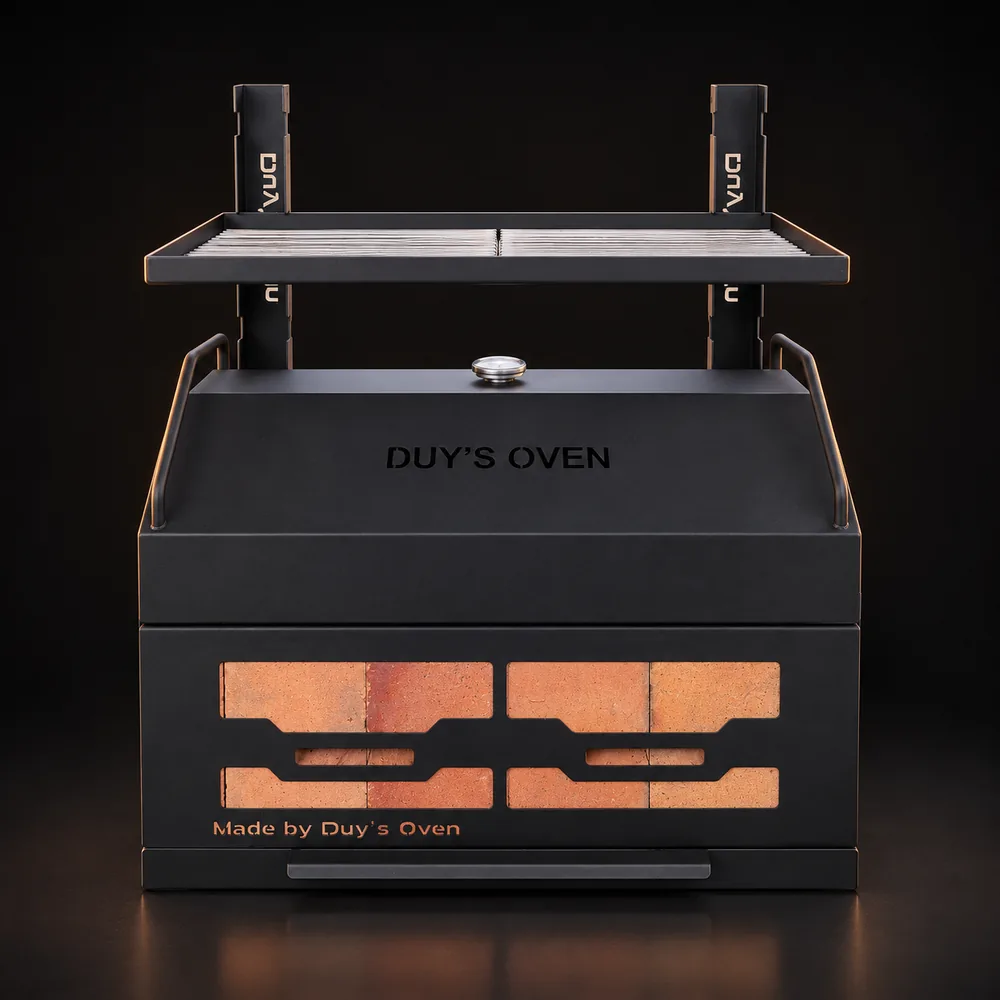
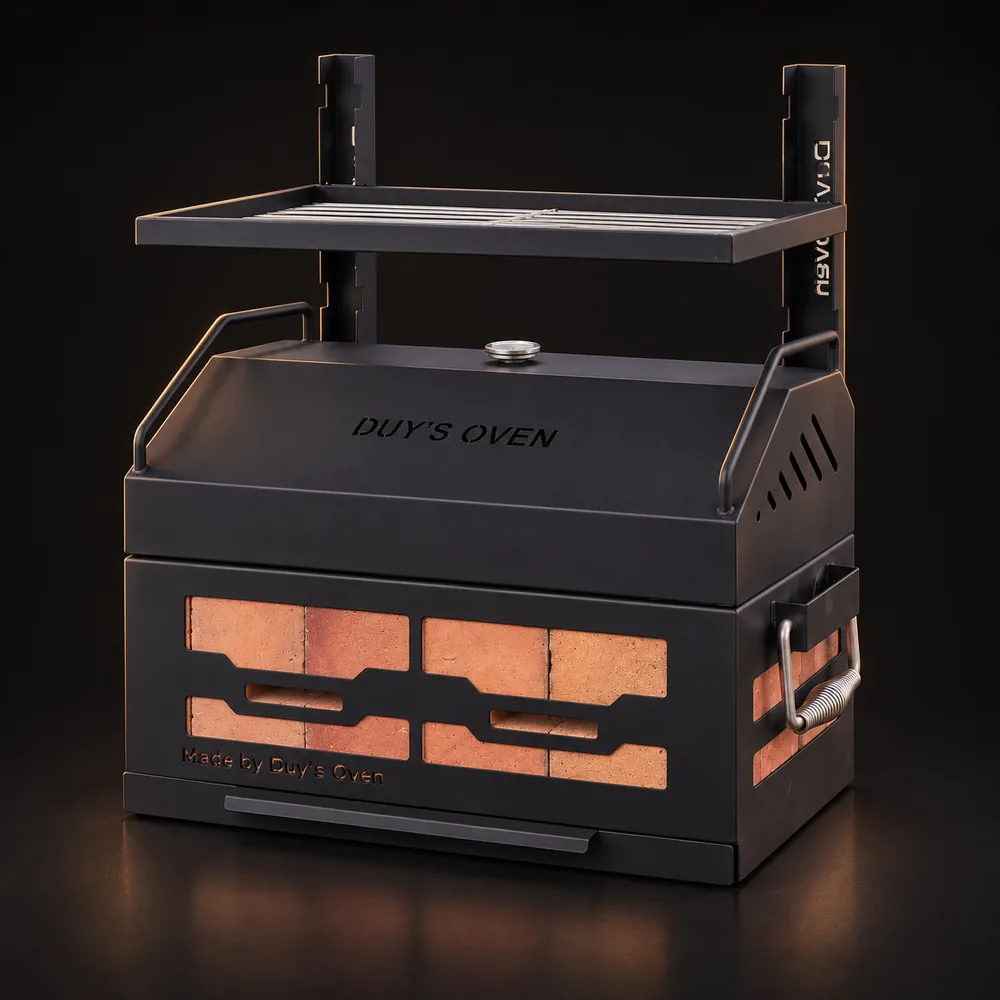
Close the double-layer lid and grill just as you would on the Smoke-Reducing Yakitori Grill: the grease tray catches most of the fat drips, while the lid holds the heat inside the grill interior. At the same time, you can hook the hanging grill-rack frame onto a high notch above the lid as a resting spot for meat skewers after grilling.
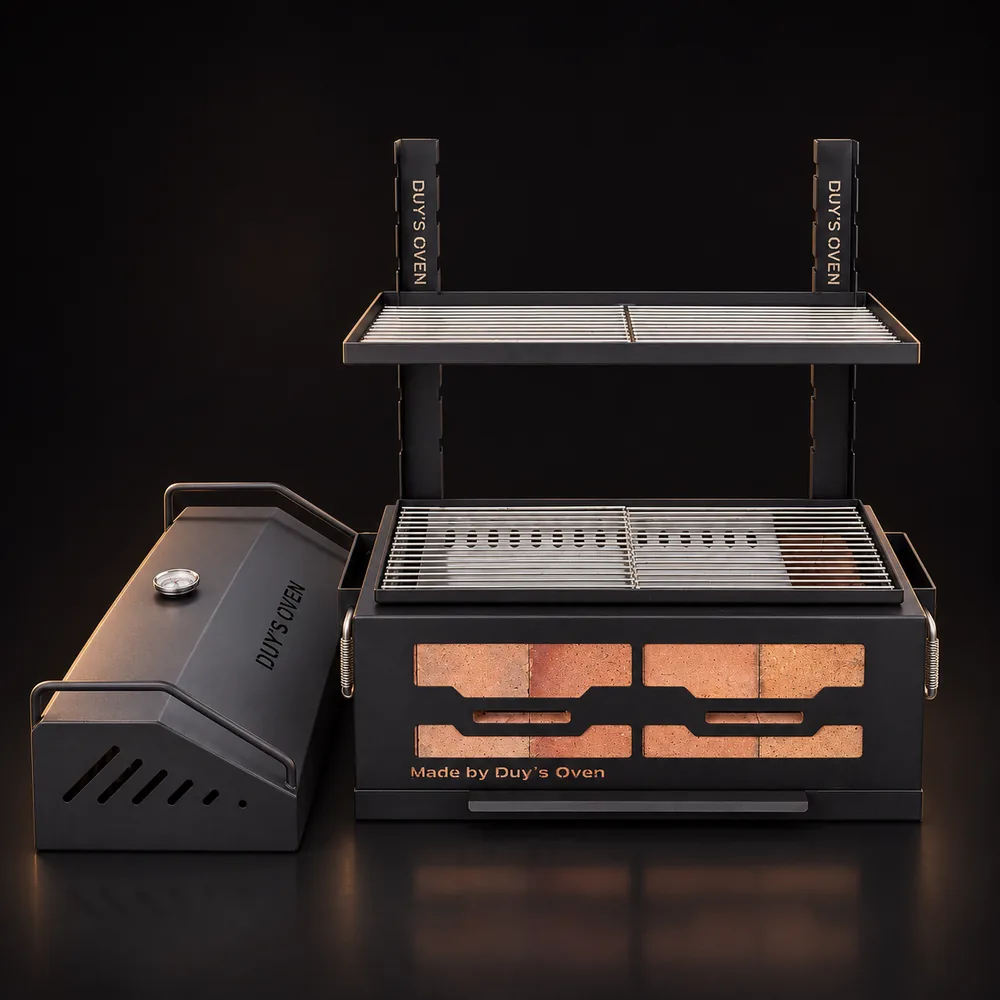
Remove the lid and hook the grill-rack frame onto the lowest notch, and the grill has two-tier racks: the main grate sits deep in the grill interior, with the hanging grill-rack frame right above it. The lower level is close to the charcoal for high heat, while the upper level sits farther from the charcoal for gentler heat. If you want the upper level gentler still, hook the frame onto a higher notch, with each notch moving it another 10 cm away from the charcoal.
Burning charcoal gives off carbon monoxide: grill only in a well-ventilated place.
Most of the fat drips onto the tray instead of straight onto the charcoal, so smoke is greatly reduced.
Closing the lid keeps the heat inside the grill, and checking the thermometer on the lid tells you how hot it is.
The meat sits between the charcoal below and the hot brick walls around it, so it is cooked evenly while staying juicy.
After grilling, pull out the steel plate, scrape the ash down into the tray on the grill floor, then pull the tray out to empty.
The Plus version no longer has a sliding air vent. After using the grill for a while, our workshop found that almost everyone opens the air vent all the way while cooking, so this version has four built-in air holes.
Following customer feedback, the screws on the grill body in this version sit flush without protruding.
See the smoke-reducing principle in the Smoke-Reducing Yakitori tab →
| Model | Smoke-Reducing Yakitori Grill Plus · Duy's Oven |
|---|---|
| Line | Yakitori, smoke-reducing version with grate lift posts |
| Oven body | 60 × 30 × 40 cm (L × W × H, with lid) |
| Lift posts | Two U-bent 1.4 mm steel uprights, 50.8 cm long, with cut-out DUY'S OVEN lettering, bolted on for easy removal |
| Notches | Four notches spaced 10 cm apart, 30 cm lift range |
| Hanging grill-rack frame | Holds two grates, hooks into the notches |
| Heater Shell | Steel in black heat-resistant paint with window cut-outs showing the brick |
| Grill interior | Heat-resistant brick |
| Lid | Double-layer, removable, with thermometer, stainless steel handle and vent slot |
| Smoke-Reducing | Stainless steel grease tray with a row of long slots |
| Main grate | Stainless steel, set deep in the chamber |
| Ash tray | Yes, pulls out at the bottom |
| Air vents | Four fixed air vents |
| Fuel | Binchotan or regular charcoal |
| How to use | Lid closed, it cooks like the Smoke-Reducing version · lid off, hang an extra grate tier |
| Origin | Duy's Oven workshop in Nha Be |
| Warranty | 12 months |
| Price | 12.980.000₫ VAT included |
The standard version of the Smoke-Reducing Yakitori Grill comes complete with the grease tray, double-layer lid and ash tray, just without the lift posts and hanging grill-rack frame.
Open the Smoke-Reducing Yakitori tab →Drop by the Duy's Oven workshop in Nha Be or message us, and we'll show you how to attach the lift posts and use the two-tier racks.
Order on duyoven.com Contact us now: 0901 691 717 Chat on Zalo